Sunday, May 17, 2015

The Stage Route and the Driver: Waterford, Vermont

Here is the schedule of the stage route from 1848, found in a guidebook to New England called "The Eastern Tourist." Note Waterford, listed as 7 miles from St. Johnsbury, Vermont, with 12 miles onward to Littleton, New Hampshire. Also see the final line, under the first chart: "Usual time from Burlington to Portland, 2 1/2 days."


Not only was Waterford a significant stagecoach stop -- it also included a family known for driving the stages. Here is the obituary for Charles T. Hill, who was born January 20, 1842, and died September 18, 1930; the Hill family lived where the Gingue dairy farm now is, and the little cemetery on the farm is called the Hill Cemetery. Some of the Hills are buried there, Charles was buried in the one in East St. Johnsbury, now called Grove Cemetery.
Well Known Stage Driver Passes Away in Waterford

Charles T. Hill, for 20 years a stage driver plying on routes between Hardwick and Lancaster and Lyndon and Island Pond and later a hotel owner in East St. Johnsbury passed away at his home in Waterford Thursday at the age of 99 years following an illness of less than a week. Mr. Hill, who was a life long resident of Waterford was born Jan. 20, 1842, the son of Ambrose and Louise Foss Hill. He was a descendant of a long line of stage drivers. He attended the public schools of Waterford and was united in marriage with Julia C. Young of Waterford, Nov. 15, 18874. To this union nine children were born, five boys and four girls, all of whom survive with the exception of one daughter.

The children who survive are George A. Hill of East St. Johnsbury, Miss Lettie E. Hill of Waterford, Wilbur C. Hill of St. Johnsbury, Miss Edna M. Hill of Riverside, Conn., Robert W. Hill of Gilman, Benjamin C. Hill of St. Johnsbury, Wallace S. Hill of Plainfield and Miss Elsie L. Hill of Waterford. He is also survived by 11 grandchildren and two great grandchildren.

Funeral services were held from his late home at 2 o'clock this afternoon. The Rev. E. E. Grant officiated. Interment was in the East St. Johnsbury Cemetery.
The site where I found this obituary also included a card of thanks from Mr. Hill's family members, and a poem that must have run in the newspaper in 1932:
           IN MEMORIAM
In loving memory of our dear,
dear father, Charles T. Hill, who
passed away Sept. 18, 1930.
Out on the sunny hillside
   Where granite marks the spot
Just two years ago dear father
   We placed you in the lot.
Not dead to us who loved you.
   Not lost but gone before,
You live with us in memory still
   And will forevermore.
                    Inserted by his children.
Finally, although no photos of the stagecoaches in Waterford have been found as yet, I located one this week that shows stagecoaches from sometime after 1865, in a parade in Bethlehem, New Hampshire:

Friday, May 1, 2015

Butternuts, for Old Time's Sake -- and Next, Rhubarb

Butternuts

Singing makes any task more fun, right?
Last November we were able to purchase four pounds of butternuts from Native Nuts in North Troy; two pounds headed to New Hampshire to catch up with Geneva Powers Wright, and the other two pounds, in a basket, came to visit at a Waterford Historical Society meeting in February, when a few brave folks took a couple of them home to try cracking.

Most of this two-pound batch ended up at my house, and I was glad to catch my son Alexis and his NYC friend Jem as labor for cracking them in March. Based on a description from an East St Johnsbury resident of having cracked them using her dad's workshop vice, we tackled the task with a pair of large screw-type carpenter clamps. (We did test an ordinary nutcracker, and it was totally useless for this job!) Sorting the nuts from the shell fragments turned out to be quite a challenge.

It took the three of us TWO HOURS of steady work to crack all the nuts and set aside the nutmeats -- which added up to slightly less than one cup full. For the April meeting of the Waterford Historical Society, I baked cookies with the little flecks of nuts -- which were delicious, but in every cookie there was at least one tooth-jarring bit of nutshell, and in some there were half a dozen. And we thought we had these well sorted!

I'm glad we tried this, for the sake of knowing how to handle butternuts, which used to be a traditional food in this region, before the trees were stricken by a mostly fatal disease. All things considered, though, I don't think we'll repeat this!

Next on my old-time cooking schedule will be rhubarb recipes, figuring out the best ones for the Waterford Historic House and Garden Tour and Rhubarb Café, being held June 20!


Saturday, April 25, 2015

Update: Waterford Slate Company

The original stone for early Waterford settler Mrs. Submit Adams, pictured here, was made of slate.
So far, I find no connections to Wales among the principals of the Waterford Slate Company -- but I do have some information to pull together here.

First, the Waterford Slate Company was incorporated in 1853 by an act of the state legislature, and the corporation members are "Otis G. Hale, Samuel G. Bracket, and Samuel A. Bracket, their associates and successors." Their first corporate meeting was to take place in St. Johnsbury.

Next, from a report by C. H. Richardson, Ph. D., Syracuse University, called "The Areal and Economic Geology of Northeastern Vermont," published in Montpelier by the Argus and Patriot Press in 1906:
The Waterford Slate Company in 1855 spent several thousand dollars in developing the quarry on Waterford Mountain two miles south of East St. Johnsbury on the St. Johnsbury and Lake Champlain Railroad. In 1860 it is reported to have been sold to WEbster and Keys of Concord, New Hampshire, for $7,777. They became involved in litigation and a foreclosure ensued. There seems to be no reason why the quarry should not be worked at good profit with modern machinery and modern methods. I have split with a single blow of a trimming hammer samples three feet long and from two feet thick to the thickness of one quarter of an inch. The grout around the old quarry exposed for half a century shows how stoutly the slate will resist disintegration. A seventy five foot front can easily be obtained with excellent opportunity for grout beds.
And the 1861 "Final Report on the Geology of Vermont: Descriptive, Theoretical, Economical, and Scenographical" by Hitchcock, Hager, Hitchcock, and Hitchcock praises the quarry, saying it has "The greatest width of slate suitable for working in any bed visited on this formation" and that "In 1855 there were about forty squares of slate quarried at this place, which were sold and used for roofing, since which time little has been done by the company." The authors said that the "slate of this belt is very tough, and in many places is in all respects equal to the best slate of Wales."

Find the words "Slate Ledge" just below Waterford Mountain. From Beers Atlas 1875.


Thursday, April 16, 2015

"Selling Scales on the Road"

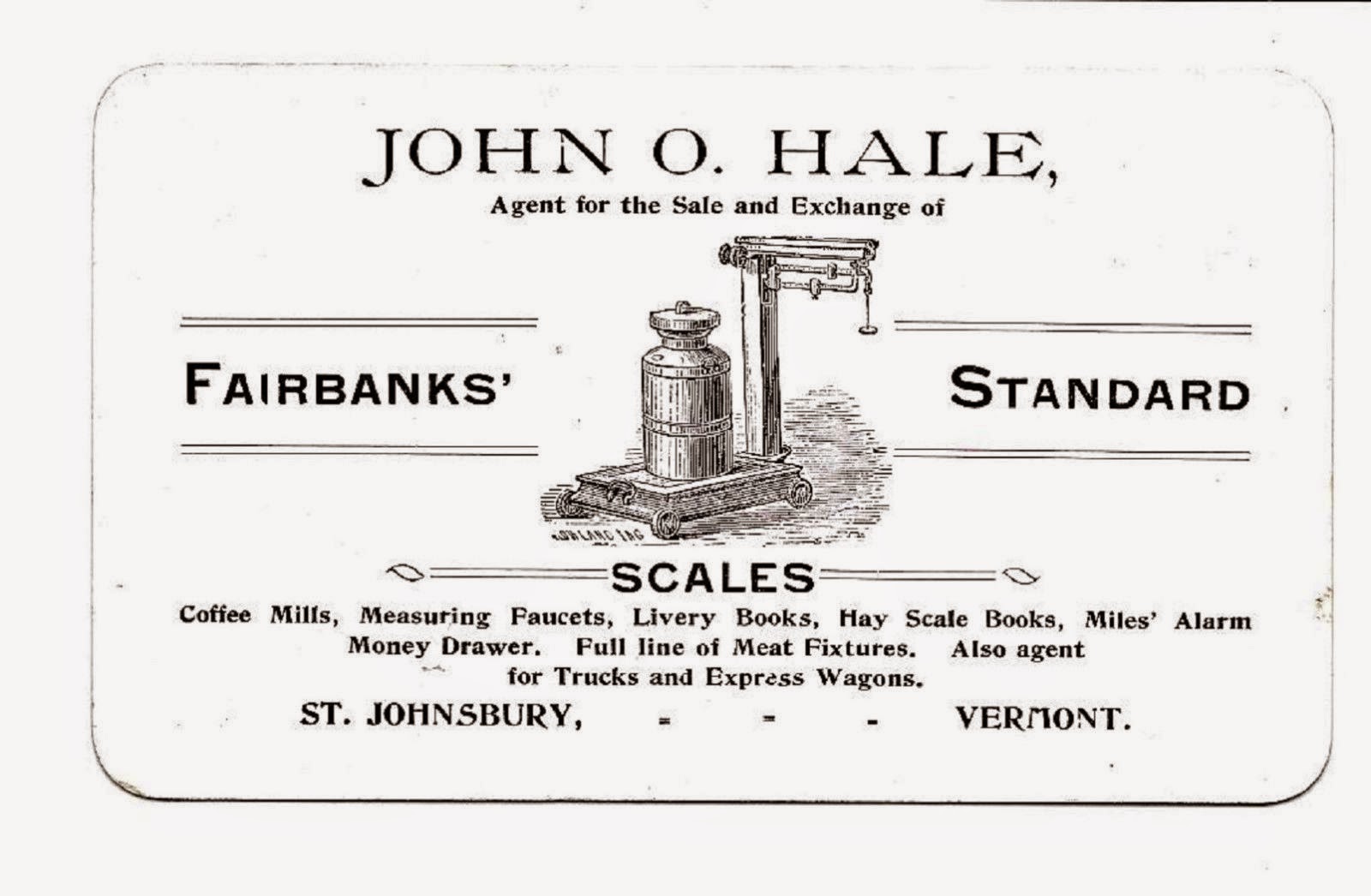
You never quite know what you'll find when you pick up a postcard or letter with local ties, like the items in the last post. But sometimes the item just isn't in the week's budget, and that was the case for this wonderful calling card recently sold on eBay. Fortunately, the image could be captured from that website. So, given this business card of John O. Hale, an agent for "Fairbanks' Standard Scales" around 1880 (a guess), what can we find out?

Fortunately, the 1880 Census and a reported family tree yielded a LOT of information! John was born on March 14, 1835; his parents, Otis Goss Hale and Eunice Pierce Hill, were both Waterford folks. John married Laura Ann Holbrook and they had a large family: Carrie, George, Addie, J. (John) Otis, Arthur, and William H. (Holbrook?). John O. Hale lived until June 11, 1910.

The 1880 Census described John's employment (could we have guessed from his card?) as "selling scales on the road."

The next obvious question is, was John related to O. Dean Hale, who owned the store on Main Street in St. Johnsbury now housing Umbrella and Secondhand Prose? (O. Dean Hale was the father of Richard "Ritty" Hale, well known in the region for his artwork.) In spite of the "O." in both names, it appears there was no near connection -- O. (Orvis) Dean Hale was born in Danville in 1887 (d. St. Johnsbury 1970), and his father Orvis Elisha Hale (1839-1920) was from Plainfield, and grandfather Valorus Waldo Hale was from Cabot.

Always worth taking a look at these fleeting scraps of our past!

Sunday, April 12, 2015

Victor Lawrence, Inventor, connecting to Amos B. and Amos H. Carpenter of West Waterford

The Waterford Barn Census includes the Lawrence-Lund carriage barn, and with its documentation (http://waterford-vt-barn-census.blogspot.com/2013/09/lawrence-lund-carriage-barn-1920s.html) mentions Victor Lawrence.

The 1889 volume of Scientific American, on page 218 (April 6), mentions a patent issued to him:
RECENTLY PATENTED INVENTIONS, Mechanical.
PLANING MACHINE CUTTER HEAD — Victor V. Lawrence, Waterford, Vt. This head is made with end pieces having short integral journals projecting from their outer sides, parallel portions connecting the end pieces, which are separated by a clear space extending their whole length, and have flat inclined knife beds tangential to the side of the cutter hears, leaving room for the clips, the invention also covering various other novel features.
The next year, 1890, the U.S. Patent Office noted that Victor Lawrence had assigned a half interest in this patent, and in another one for a planing machine, to I. H. Paul, Boston, Mass., and A. H. Carpenter, West Waterford.

A. H. Carpenter would have been Amos Herbert Carpenter (born 1855), son of Amos B. (Bugbee) Carpenter -- who in turn was the postmaster in West Waterford from Jan. 5, 1856, to April 21, 1862.

Last week I was able to obtain an envelope postmarked 1889 from West Waterford to Amos H. Carpenter, and in it was a letter from his father, Amos B. Carpenter, mentioning Victor Lawrence!

                        West Waterford Jan. 13 1889

Dear Herbert
     I went up to see Abel on Saturday. Yesterday. Your mother went with me. It appears that Abel is failing at least he grows no better still he thinks he is some better in some respects and worse in others.
     I was in there about an hour & he seemed to be tired all out. I went out to let him rest. but when I returned he did not appear rested much.  It would be nothing strange if he did not live two weeks still he may get well. The village people think it doubtful.
     He had just received your letter and requested me to write you that he is not able to answer it but would be glad to receive letters from you.
     Wednesday we meet to complete those vistings [?]. I think they will all be there if it is a good day -- I have not heard from Haynes but I think he will come.
     Clinton & William say they will be there on time.
     Will send the papers soon as completed to you at Stockton.
     I shall take your letter over to St J and have Dunnett read it to them if necessary.
     Mrs. Asro Brown is very sick. The neighbors think she will not live only a few weeks to the most cannot take any food.
     I went up to Vic Lawrences last week to see if those yearlings were all right, I found only the two heifers, — I talked a few minutes with his wife. She told me that she knew that I had a claim on them but wanted to keep them for cows. I merely said that I expected Vic would pay for them when he returned. She made some inquiries about him. I answered that I knew nothing about his going to Cal or about the patent.
     She says he wrote in his last letter that he should be back in March.
     I saw Morrill who is on the place after I saw her and he told me they killed the Bull by Vic's order and that he did not know that I had any claim on them, that Mrs Lawrence had been trying to sell them, which I doubt some, as by appearance I should believe her sooner than Morrill.
     He says there will not be hay enough to last longer than the middle of February and he should not buy hay but was willing to take good care of them as long as it lasted.
     I told him when it was gone to drive them down to me; he said he would do it and let me know so that I could get them. I cam glad that I went up to see them as I think now they will be kept and delivered to me when the hay is gone.
     No snow yet. The ground is nearly as bare as in June.
     If there is anything you want of Abel you had better write at once it will be impossible to reach all the children.
     Write often, I have written every week since Thanksgiving if not received they are lost —
     Your affectionate Father A B Carpenter

A quick check of US Census records for Amos H. ("Herbert") Carpenter shows his birth in Waterford in 1855, residence in Waterford in 1860 and 1870, residence in Derby, VT, in 1880, and he shows up on the Stockton, Calfornia, Census pages for 1910, 1920, and 1930; he died on Nov. 10, 1933, in Stockton, California, and was buried May 12, 1934, in St. Johnsbury, Vermont. His mother was Cosbi Bowman Parker, born in 1828 in Littleton, NH to Ezra Parker (b. 1791, Pembroke, NH) and Hannah Burleigh (b. 1800, Sanbornton, NH).


Saturday, April 11, 2015

Searching for the Mills: Captain John Stiles Arrived in 1797

Ice fishing at Stiles Pond, January 2015.
Waterford's own printed history, A Vermont Village, says almost nothing about the Stiles family that settled in the area in 1797. But because Captain John Stiles built a sawmill on the large pond -- now more of a lake, but still called Stiles Pond -- that would become the water source for neighboring St. Johnsbury, his story shows up in Town of St. Johnsbury Vermont. This sizeable tome was written by Edward T. Fairbanks, a member of a family of industrial entrepreneurs who made their fortunes by harnessing the water power of the region and adding a hefty dose of creative invention and steady labor.

Fairbanks notes the military rank of this settler -- most likely a rank gained in a militia company, as he was born in 1774, just before the Revolutionary War. His parents were John Stiles (1749-1818) and Keziah Divoli (1748-1819), and he married Annie Hill in 1802, a few years after he'd arrived in Waterford. Here is the Fairbanks summary of his background and achievements:

Fairbanks goes on to describe how Stiles pond became St. Johnsbury's water source, as follows (note that Summerville was then the name of the east side of St. Johnsbury, at the other side of the Passumpsic River, before the region was adopted into the larger town):


There are no signs of the Stiles millworks today. And of the Stile "mansion" across Route 18, only a stone wall remains along the road. I've searched the records for several months, looking for when the "mansion" was removed, and it looks as though its demise came in the 1930s, as Route 18 was rebuilt and the Depression caused many changes. No photos of the home seem to have survived.


Wednesday, March 25, 2015

The Pike–Streeter Tavern, Upper Waterford, Vermont

Child's Gazetteer of Caledonia and Essex Counties, Vt., 1764-1887 (1887), offers some early history of Waterford:
The first saw-mill was built by Solomon Pomeroy, just below Mrs. Hibbard's brick house, at Upper village. John Stiles built a saw-mill at the outlet of Stiles pond, in 1807, and also built an oil-mill here in 1818. The first hotel was built by Warner Call, nearly opposite the store at Upper village. Nathan and Dennis Pike built the Streeter tavern in 1823, and kept it for many years. The first school kept in the eastern part of the town was by Candace Billings, in Daniel Pike's barn. The first church was built in 1818, near the center of the town. It was a large two-story structure, with a gallery on three sides.
... Daniel and Nathan Pike, Jonathan Hutchinson and Luther Knight came to Waterford, form Royalston, Mass., and located in the eastern part of the town, in 1792.
There's a lot in there to examine and compare with today! The "Upper village," or Upper Waterford, is gone -- sacrificed in the 1930s to plans to build the Moore Dam on the Connecticut River, which would create a lake at the village location. The Upper village, where Daniel and Nathan Pike settled, was the eastern part of town and was called "Upper" because it was up-river from the rest of the town.


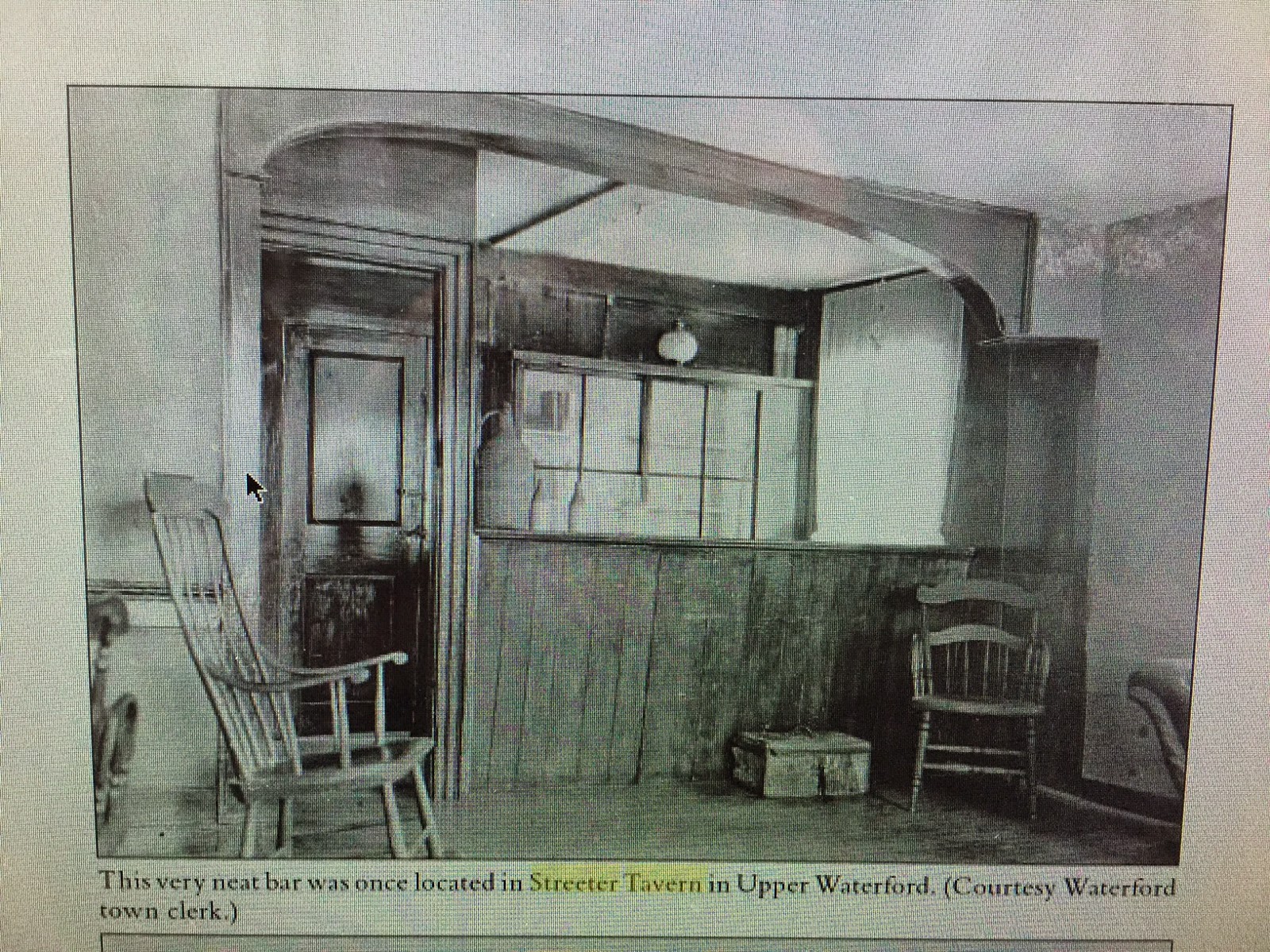
More about the tavern, the Pikes, and their significance in the town is found in Frederic J. Wood's 1919 tome, The Turnpikes of New England. These were the toll roads, set up for commerce (and to let the landowners and road owners earn some fees). Here are the actual pages -- with page 260 being the one with the photos, above.


Dolores E. Ham brought out the book Caledonia County (Images of America) in 2000 (now available also as an ebook), and used two images of the Streeter Tavern in it, borrowed from the Wateford Town Clerk. Here they are:


And finally, of course, Gordon Hopper's Upper Waterford—A Village Lost to Progress offers the most detail on the history of the tavern. He writes that Nathan and Daniel Pike had a small farmhouse located at the crossroad in the village, and they converted it into a tavern in 1823. "The building was used for public gatherings, dances, religious and political meetings." After some years, the Pikes' tavern was taken over by Jeff Hosmer. In 1864 Timothy Streeter bought it; he closed it in 1874. Hopper says that "its patronage included stage coach drivers and passengers, freight wagon drivers and teamsters, drovers, drummers, private travelers, summer boarders, local barflies and those who needed a public hall. Balls and parties, meetings, funerals and court sessions were helpd in the old tavern and for a short time, part of it served as the town's library" -- with librarian Caroline Streeter.

The building then became a private home, and in 1926 it was purchased by the Connecticut RIver Development Company. Hopper says that it was used as a rooming house for men constructing the dam, until destroyed by fire "of an unknown origin" on January 1, 1930.

He also mentions Eugenia Powers' description of the interior of the tavern, which appeared in the 1978 Waterford Town Report (to follow).