The Waterford Historical group met at the Davies Memorial Library on July 25 and heard from four people who'd attended the former district ("one-room") schools as children -- a great evening, and there's a similar one planned for August 22, at 6 p.m. Many thanks to all. Count on video footage being available sometime next year, from these events (our editing process is slow but steady).
Meanwhile, it's also great that surrounding towns are sharing with us. Here's an invitation from the Peacham Historical Society -- which also raises the question: Who in Waterford went West during the Gold Rush? There is one stone at the Riverside Cemetery that says the person died in California -- anyone have a story to go with it?
Hope you'll want to post some local history here soon.
* * *
Peacham Historical Association Plans Annual Meeting
Wednesday, August 1, 2012
The Peacham Historical Association will hold its annual meeting on Wednesday, August 1 starting at 7 p.m. at the Peacham Congregational Church. Following the Association’s business meeting, the evening program will begin at 7:30 and is entitled: “He Says, She Says: A Shared 19th Century Diary.” The featured speaker, well-known archivist Lynn A. Bonfield, will read from the shared journal that Alfred S. Rix and Chastina Walbridge Rix started in Peacham on their wedding day in July 1849. For almost five years they alternated entries, writing about the birth and raising of their son, Julian, Alfred’s teaching at the Peacham Academy and studying law, his law practice, and the decision to go to California. Their shared journal is unusual in describing the difficulties created by Alfred’s decision to go to California and Chastina’s struggle to make the trip to rejoin her husband in San Francisco. Lynn A. Bonfield edited the journal, which was published in 2011.
The program is open to the public and admission is FREE! The evening will end with dessert and conversation downstairs in the church.
Mark your calendars! We hope to see you on August 1.
Saturday, July 28, 2012

Wednesday, June 27, 2012
Waterford Historical Group (Met on June 27)

Next meetings: July 25 and August 22. Invited guests who attended Waterford's district schools, before the current unified school was built, will help us learn what "school days" were like in the 1940s and 1950s. Come for the stories (and good company, and some cookies). Always at 6 pm in the Davies Memorial Library, Waterford, VT.
Saturday, May 26, 2012
"Waterford Historical" Marks Memorial Day Weekend With Grounds Work at Riverside/Pike Cemeteries
Armed with a plot map that Matt L. put together, we checked the entire Pike Cemetery section of Riverside first, looking for any turf-buried stones (none found) and correcting the map for a few placements that had changed.
Then some of us worked on trimming turf around ground-level stones that were getting covered by the lawn growth -- and despite two-plus hours, barely covered 20% of the work needed. Another session would be great! At least two stones need repair that we couldn't do, and one was successfully reset, thanks to Roberta S. and Barb C.
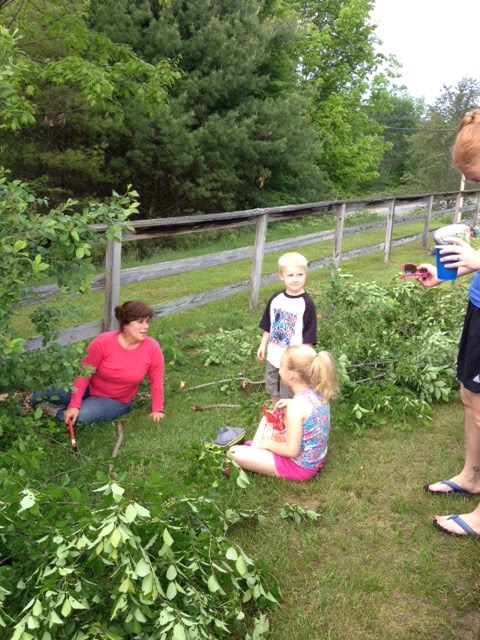
Olivia helped Colleen K. with pruning, and others worked on fence repair. Olivia's birthday-boy brother stopped in to visit, with their mom. Helen P. labored over the stone of her father's little sister Violet, and noted that her own stone (crafted to remind us of her "Greetings From New Jersey: A Postcard Tour of the Garden State" book) was incorrectly placed and needs to be trimmed to size and placed between the stones for her parents. The dog assisting us came with Nate D. and is named Memphis -- a Southerner taking part in Yankee labor today, May 26.


Then some of us worked on trimming turf around ground-level stones that were getting covered by the lawn growth -- and despite two-plus hours, barely covered 20% of the work needed. Another session would be great! At least two stones need repair that we couldn't do, and one was successfully reset, thanks to Roberta S. and Barb C.
Olivia helped Colleen K. with pruning, and others worked on fence repair. Olivia's birthday-boy brother stopped in to visit, with their mom. Helen P. labored over the stone of her father's little sister Violet, and noted that her own stone (crafted to remind us of her "Greetings From New Jersey: A Postcard Tour of the Garden State" book) was incorrectly placed and needs to be trimmed to size and placed between the stones for her parents. The dog assisting us came with Nate D. and is named Memphis -- a Southerner taking part in Yankee labor today, May 26.


Wednesday, May 23, 2012
Waterford, VT, in ORANGE County?
Yes, if you're accessing early records of Waterford -- especially back to the days when the town was called Littleton -- the correct county name is Orange, NOT Caledonia.
Also note that, according to the Vermont Census Finder website (http://www.censusfinder.com/vermont.htm), the year of a Census record can be misleading: "The 1790 Federal Vermont Census was actually taken in 1791 when Vermont became a state. This can cause confusion as an individual may be enumerated in the 1791 Federal census of Vermont but could have actually been living in a different state in 1790. When conducting genealogical research in Vermont, beware of this common pitfall."
Here's the 1790 Census record, courtesy of that site and VTGenWeb:
Also note that, according to the Vermont Census Finder website (http://www.censusfinder.com/vermont.htm), the year of a Census record can be misleading: "The 1790 Federal Vermont Census was actually taken in 1791 when Vermont became a state. This can cause confusion as an individual may be enumerated in the 1791 Federal census of Vermont but could have actually been living in a different state in 1790. When conducting genealogical research in Vermont, beware of this common pitfall."
Here's the 1790 Census record, courtesy of that site and VTGenWeb:
Waterford, Caledonia County, VT
1790 Census
The first census of the United States was taken in 1790. Six information fields were recorded: 1)Name of head of family; 2) Free white males of 16 years and upward, including heads of families; 3) Free white males under 16 years; 4) Free white females, including heads of families; 5) All other free persons; and 6) Slaves.
Please note that at the time of this census, the town was called "Littleton" and was located in "Orange County".
Please note that the census is transcribed exactly as it was printed and that Heads of Families may not be in alphabetical order. Please also note that there are several misspellings of surnames.
| Head of family | FWM16+ | FWM16- | ||||
|---|---|---|---|---|---|---|
| Adams, James | 2 | .. | 1 | .. | .. | xx |
| Brown, James | 1 | .. | 2 | .. | .. | xx |
| Felton, Joseph | 1 | 2 | 2 | .. | .. | xx |
| Hamlet, William | 1 | 1 | 6 | .. | .. | xx |
| Knoulton, Thomas | 1 | 2 | 1 | .. | .. | xx |
| Morgan, Cornelius | 2 | 2 | 4 | .. | .. | xx |
| Pike, Nathan | 3 | .. | 3 | .. | .. | xx |
| Potter, Barnabas | 2 | 2 | 3 | .. | .. | xx |
| Sylvester, Peter | 1 | 1 | 2 | .. | .. | xx |
| Wood, John | 1 | 4 | 3 | .. | .. | xx |
| Wood, Joseph | 1 | .. | 6 | .. | .. | xx |
Monday, March 5, 2012
Waterford's District Schools
 |
| 1928 Waterford School, courtesy of James Cross. |
The "Waterford Historical Group" (meeting at the Davies Memorial Library each month) is focusing this year on the schools. Historian David Carpenter described three schools before 1800: Districts 1, 2, and 3. By 1801, he wrote, there were 181 "scholars" and seven school districts. In 1812, the town boasted 554 school-aged children, with the older ones more likely to attend in winter (when there was less work for them) and the younger ones in summer (long walks in cold weather and sitting in a barely heated schoolhouse were hard for them). Here's a description of the districts in 1830, taken from David Carpenter's write-up in the 1987 Town Report:
District #1 (information about this district is proving to be elusive).
District #2 the original school house site is where the Gilbert Wright residence is now located on Town Highway (TH) 19.
District #3 the "Lower Waterford School," now the Flocks residence in Lower Waterford village.
District #4 the "Woods School" at the intersection near the David Morrison place (physically moved there from its original location on TH 13below the Mervyn Morrison place).
District #5 believed to have been known as the "Calvin Brown School" at the top of Cushman Hill near the Thompson place.
District #6 the "Graves School" about where Vermont Highway 18 crosses Interstate 93.
District #7 the "Hastings School" on TH 35, now the Howe residence.
District #8 near the Belknap place at the intersection of TH's 7 and 9.
District #9 the "Hill School" at the intersection of TH's 38 and 39 near the Reginald Willson place.
District #10 the "Green School" at the intersection of TH's 28 and 29 adjacent to the Gagne place.
District #11 the "Gaskell School" on TH 12 across from the Kelley (formerly Morrill) place.
District #12 between the Billig and Austin places on TH4.
District #13 the "Upper Waterford School" whose site is now underwater in the Moore Reservoir several hundred feet out from the New England Power Company boat launching ramp.
District #14 the "West Waterford School" on TH3, now the Root residence.
Did you attend one of these schools? Have memories to share? The Waterford Historical Group would like to hear from you.
For example, as Dave Morrison recollects the schools (he started in 1952), Lower Waterford School has no running water, and their were two outhouses, one for boys, one for girls. Graves was the "most luxurious," with running water, two toilets downstairs, a kitchette, a stage, even a full basement. And the first "bus" he ever rode in was a station wagon driven by Wayne Lewis's aunt Mrs. Pelletier.
Through 1953, the four final schools served eight grades each; in 1954-1956, each one had four grades instead, and "busing" or other forms of transportation were needed. Students gathered all together only once each year, in June, at the church in Lower Waterford, for the Grade 8 graduation.
What do you remember? Most important, WHO do you remember? Classmates, teachers, visitors?
Thursday, February 16, 2012
Waterford's Civil War Soldiers' Record
I am posting all the pages here (scanned with help from Dave Kanell; thank you!). If you compare the names here against the cemeteries, there may be some discrepancies. Anyone interested in doing the full list, from these images plus the cemetery posts I've placed here earlier?
REMINDER: Next Waterford Historical meeting is on Wed. Feb. 22 at 6 p.m. at the Davies Memorial Library.


REMINDER: Next Waterford Historical meeting is on Wed. Feb. 22 at 6 p.m. at the Davies Memorial Library.


Sunday, February 5, 2012
Quarrying Slate in Waterford
 |
| Llechwedd Slate Mine, Blaenau Ffestiniog, Wales |
If you live on Slate Ledge Road in Waterford, or have driven past it, or studied the old town maps, you already may know: There was a slate quarry here. Slate is one of the three "state rocks" of Vermont (the other two are granite and marble), and when the legislature declared that status in 1991, it also spelled this out:
Slate
Metamorphic rock found in southwestern Vermont. It is formed by the compaction and heating of clay, silt or mud. Vermont slate varies in color from red, green, black and purple. Because it splits into thin slabs, slate is used for roofing shingles, sidewalks and floor tiles.
Slate: Three ranges of roofing slate:
From Office of the Secretary of State, Vermont Legislative Directory and State Manual, Biennial Session, 1993–1994, p. 23.
- Eastern, clay slate near Connecticut river, from Massachusetts line to Essex county; found in Guilford, Windham county; Thetford, Orange county; Waterford, Caledonia county; and other localities and small quarries.
- Middle range of clay slate extends from Memphremagog lake to Barnard slate quarries in Northfield, Montpelier, and elsewhere of uniform shade and black.
- Western Vermont slate quarried largely in Castleton; also in Fairhaven, Poultney, Wells, and Pawlet, Rutland county; generally of a dark purple color, with occasional blotches of green; very compact and fissile. Large quarries near West Castleton, Hydeville, Scotch hill, and Fairhaven.
In 1958 the Vermont Geological Survey under Charles G. Doll issued a report by John H. Eric and John G. Dennis called "Geology of the Concord–Waterford Area, Vermont." On page 62 of the report, Eric and Dennis say, "Waterford Slate" (Richardson, 1906) was quarried on the southeast slope of Fairbanks Mountain, at the locality marked on Plate 1. This operation ceased about the time of the Civil War." (The C. H. Richardson 1906 report cited here is "The Areal and Economic Geology of Northeastern Vermont.")
Shortening up the language, what we probably get from this is: Around the same time when Waterford's population changed during the Civil War, with so many young men leaving to fight for the Union, activity at the slate mine dried up. Whether this was from the lack of working men or from changes in how people roofed their homes isn't clear. Or, I suppose, the quarry could have run short of easily mined, good-quality slate. However, that seems unlikely, since any casual drive along the nearby interstate today reveals pockets of slate cleaving off the rock walls.
It interests me that the minerals likely to be found in slate-quarry regions are biotite, garnet, staurolite, and pyrite. I recall gathering these, as a child, at a former mine site in northwestern New Jersey.
In nearby Littleton, NH, the American Slate Company spent about $70,000 to open a quarry, as described in Child's Gazetteer of Grafton County (1886). Child's Gazetteer describes the quarry and its slate deposit as "equal to the Welch" -- and the "ch" at the end is not a typing error. In this region, today's term "Welsh" (as in, someone or something from Wales) was pronounced with a -ch ending, and it makes sense that it was also spelled that way. (I learned this from Miss Karlene Exley, late of West Barnet, VT.)
Because Welshmen were known to be the best miners of slate, I checked a few reports on Welsh immigration to the United States; there was a wave of Welsh immigrants in the 1830s during the industrial revolution; many of the immigrants were highly skilled. There's a documented pocket of Welsh immigration in central Maine, but I don't see documentation for Vermont.
Which Waterford families have ancestors who came from Wales? Was the town's slate quarry opened or operated by people from Wales? Which homes or barns in town have slate roofs? And why, indeed, did the quarry close? These are all active questions. If you have ideas, suggestions, or information, please add them here, using the "Comment" button, or e-mail Beth (BethPoet@gmail.com).
Subscribe to:
Posts (Atom)