Showing posts with label Rabbit Hill Inn. Show all posts

Friday, January 2, 2026

Arnold Waters, Lower Waterford Resident: Diamond Mines and Community Service

Arnold Waters, 1906-1985, photo from the 1985 Town Report, courtesy of Helen C. Pike

It's easy to look at the white houses and green shutters of Lower Waterford's "White Village" and think that the residents will all fit together, New Englanders of some generation and maybe even "kissing cousins."

But the reality of the White Village,  even from its days as an important stagecoach stop, is far different. One of the residents who left wonderful stories behind of his adventurous life was Arnold Waters, with his wife Betty and, later, subsequent wife Beth.

Long-time local resident and attorney Kate Piper wrote this about the couple, back in 2007:


Arnold E. Waters, Jr., graduated with a PhD in geology in 1933 from Johns Hopkins University. After graduation he joined the Anglo American group, a diamond mining company. He spent his career exploring parts of South Africa, Northern Rhodesia (now Zambia), Indonesia, and Canada. After he retired in 1972, he and his wife, Betty, moved to the village of Lower Waterford where they purchased the house next to the Rabbit Hill Inn. Arnold was a beloved and active member of the community. He served as president of the board of the Fairbanks Museum and was later named a museum fellow. Arnold chaired the Waterford Planning Commission and served the Lower Waterford Congregational Church in many capacities. He was an avid gardener and prize-winning beekeeper who generously shared his knowledge and skills as well as his honey and produce. Betty (Elizabeth S.) Waters died in March 1977. In June 1983, Arnold married their close family friend from South Africa, Elizabeth (Beth) Hicks. When Arnold died on August 15, 1985, one of Waterford’s selectmen, lamenting his passing, described Arnold perfectly as “the cement that holds this community together.” 

Diamond mining?? Yes, indeed! The obituary written by David Lang for the Caledonian-Record said even more:

Thanks again to Helen C. Pike for this.


Years in the White Village meant that there are many other memories of Mr. Waters. Here is a reflection from Donna Rae Heath:

I first met Arnold Waters at Green Up Day at the Waterford Elementary School. I was assigned to the last remaining volunteer with a vehicle. That is how I picked up trash on a Saturday with a lanky retired geologist, both of us picking up highway garbage in his Mercedes Benz in the mid-1970s. I learned that he was still active as a geologist and a volunteer in the Waterford community. I was a farm girl recently graduated from Johnson State College after having to work thirteen years in low paying typist jobs before being able to afford college.


Later, I had been hired by the Essex County Conservation District through a one-year funded position to work on a USDA soil erosion project and administrative work for the district. Arnold was asked to be a speaker at the meeting of the district in Guildhall and offered to let me ride with him. When he picked me up in the Mercedes Benz, he opened the door for me.


When the I-93 highway construction was at the end of the planning stage and close to construction, I read some of the State’s paperwork and discovered in the Environmental Impact Statement that the access to my road, now called Walsh Rd., and the Hudson Rd. that enters Rt.18 by Stiles Pond was not to be saved. I discussed this with one of my former teachers from Johnson State College, and he gave me suggestions on what information to obtain to enter an appeal to the State. I obtained the accident rates for two other roads accessing my area versus
the intersection of Hudson Rd and Rt.18, the number of new houses built in the area, and the time for the St. Johnsbury Fire Department to arrive to my area. The access from Hudson Rd., to Rt. 18 was the safest. On my birthday evening in January, I walked the neighborhood and collected signatures to support the appeal. Only one neighbor refused.


I submitted the appeal with my research to the Vermont Transportation Agency and cc’d Arnold Waters as he was on the planning commission. Arnold called me and said the Transportation Agency had called him asking for information. Arnold promised to visit the Transportation Agency. He obtained a commitment from them to not close our access to Rt. 18 from Hudson Road, and we now have overpasses, and the road remains open.


Arnold had a face, somewhat reddish and windblown, like someone who was outdoors all the time. He was a man in his seventies, always running with a project or a job to do. My brother, Raymond, had a construction company, and Arnold had hired his crew to work on a new well for him. I remember my brother telling me how impressed he was when Arnold offered to collect tools or supplies from his house or garage. He ran down from the well site to the house and back again with whatever they needed.


Arnold Waters was a gentleman, always committed to his community, and never afraid to speak up even though he had a stutter or lisp, but always forceful in his beliefs. I try to follow Arnold’s rules, except speaking up, that’s still a little shaky.


Donna Rae Heath

Another time when memories of Mr. Waters came up was when the Waterford Historical Society hosted a "reunion" of people who owned, worked at, and for other reasons had vivid memories of the Rabbit Hill Inn, next door to the house where Arnold resided. Watch an engaging and often light-hearted video of this gathering, recorded by Donna Heath for the WHS, here.

And if you'd like to read something about Arnold Waters and the diamonds, check out The Geochemical News from January 2000 -- here's a good bit:

There are also mentions of the important role of Mr. Waters in the South African diamond mines in a 2018 conference report describing the Jwaneng diamond mine in the hands of De Beers -- Mr. Waters is decribed as consulting geologist for the famous diamond company, productively testing a theory on where to mine the gems.  

A memoir by Tom Molyneux also mentions Arnold Waters:

After a thirty-six hour journey by train across The Karoo I arrived in Johannesburg and went to the Anglo American offices at 44 and 45 Main Street. It was a Friday and I met Dr. Arnold Waters who was the Chief Geologist and a long term member of the famous Northern Rhodesian geological team of The Late Dr. Austin Bancroft. That team had been based in The Northern Rhodesian (Zambian) Copperbelt in the 1930s and they had great success in exploring for, and bringing huge copper mines to the production stage. This team was also legendary for its hard work, self-reliance, dedication and Spartan approach to field work.

After all that adventure, the most tangible sign that Arnold Waters ended up belonging to Lower Waterford is that when the village church was decommissioned a few years ago, historian and author Helen C. Pike already knew which pew had always been where Mr. Waters sat, along with his wife and their friends the Hird family -- number 12 -- and she made sure it was saved as a treasure of White Village history.


Saturday, August 24, 2024

The Rabbit Hill Inn: Dottie Starin, Working in 1962, Visiting 30 Years Later

A big thank you to Dottie Starin, née Dorothy Jean Chase, who provided a 1988 New York Times article on the Rabbit Hill Inn, as well as her own photographs from a 1992 visit there.

Dottie wrote, "I worked there the Summer of 1962 after graduating from Concord High & only worked mostly in the motel rooms through October since I remember they were not heated rooms & Fall foliage was ending. The photos were from the 90’s. Probably 1992 as that would have been when I would have been up there for a reunion with my classmates when we got together on our own." She worked with Lola Bullock, whom she recalls as a very sweet person.

Dottie also has strong connections to the nearby churches, especially the Congregational church in East St Johnsbury village. She wrote, "I was married there in June 1963 [to William Thresher] and we had my mom & dad's 50th anniversary in the Church basement in December 1990."

Here are the gems that she mailed here, from her home in Texas. Click on each image to see them better. Thank you so much, Dottie!


Wednesday, April 3, 2024

Farewell, Beryl Charlton, Former Rabbit Hill Innkeeper

 We are sad to pass along news of the death of long-time Rabbit Hill Inn innkeeper Beryl Charlton, as published in today's The Caledonian-Record. Enjoy Beryl and Eric in this video from 2018, beginning around minute 30.


Friday, February 19, 2021

Discovering Waterford 2021: What Amazed Us in 2018 Was the Rabbit Hill Inn Reunion

Author Helen Pike with retired innkeepers Beryl and Eric Charlton, 2018.

The Waterford Historical Society began as a history interest group that met at the Davies Memorial Library in Lower Waterford. People shared documents, pored over maps, set up hikes to the dams that mark the biggest changes in the physical existence of the town.

Then we formed a "501(c)3" as the Waterford Historical Society, so we could do better at taking care of items entrusted to us, from letters to paintings to donations.

And we began to focus on hosting events that would uncover, celebrate, and record the special history of this place. One of the most exciting of these happened in 2018: the Rabbit Hill Inn Reunion, welcoming people who'd worked there and hearing their stories. That's where these photos are from.

Author Helen Pike with current Rabbit Hill Inn innkeepers Brian and Leslie Mulcahy.

Board member Donna Heath, recording the "RHI Reunion." Photo courtesy of Edith Aremburg.


Tuesday, March 17, 2020

Farewell, Eric Charlton, Former Innkeeper, Rabbit Hill Inn

The Waterford Historical Society offers its condolences to Beryl Charlton and the many other family members and friends mourning the March 10 death of Eric Charlton. Beryl and Eric together owned and managed the Rabbit Hill Inn in Waterford for a wonderfully long and joyful time, 1980-1987. They also gave the community the gift of their presence at the Rabbit Hill Reunion in 2018; you can view the video here.


View the full obituary here.

Other notes here on the Rabbit Hill Inn and its history: click here.

The inn's own description of its history: click here.

Thursday, July 19, 2018

Grape-Nuts Cereal Commercial Featuring Lower Waterford

Image courtesy of ThrowAway History.
Talking about the Rabbit Hill Inn and its history always rambles around to the February 1975 commercial for Grape-Nuts cereal, where part of the filming angle is from the grounds of the inn. The cereal was considered a health food at the time, so the spokesman for the product here is Euell Gibbons, noted for his book Stalking the Wild Asparagus and other publications.

Click on this YouTube link to watch the ad! Anyone recall being an extra during the filming? (There are other Grape-Nuts ads with Mr. Gibbons on YouTube, but this is the only one set in Lower Waterford, Vermont.) All of the children of the Carroll family, the innkeepers at the time, took part.

If this makes you nostalgic or curious -- please join us Wed. July 25 at 6:30 pm, in the Community Room of the white church shown here (Lower Waterford Congregational Church), for the first ever Rabbit Hill Reminiscence Reunion, sponsored by the Waterford Historical Society.

Wednesday, July 18, 2018

The Hull Family at the Rabbit Hill Motor Lodge


Judy Hull Groskopf provided these wonderful photos from the late 1950s or early 1960s, while her father Alden "Tony" Hull managed the Rabbit Hill Motor Lodge in Lower Waterford, Vermont, along with the St. Johnsbury House. Here he is, on the porch with Judy -- and here's his wife Margaret, enjoying a break from raising three daughters with Tony.

Do you have photos of the Rabbit Hill Inn from another time period? It would be wonderful to see them. Join us at the Rabbit Hill Reminiscence Reunion, on Wed. July 25th at 6:30 pm, across the road from the inn, in the church Community Room. Refreshments and good memories to share.

Saturday, July 14, 2018

The Rabbit Hill Inn: Some History of the Main Building

The Rabbit Hill Inn as Rabbit Hill House, home of the Davies family. Photo taken by Arthur Morrison in 1937, from the roof of the Lower Waterford Congregational Church.
When the Rabbit Hill Inn was owned by the Bowman family, under the name The Valley House: "Mr. Bowman is holding the horse and Mrs. Bowman is standing behind the seated lady, whose identity is not known. The side door was used as the entrance to the Post Office. The barn seen over the roof of the ell was used to stable the horses of travellers." (Eugenia Powers, writing for the 1965 town report)
Thanks to Eugenia Powers, who gathered Waterford history from both documents and those with long memories in the 1960s, we have these wonderful photos of the Rabbit Hill Inn before it bore that name.

The Vermont historical survey of Waterford's structures, written by Allen Hodgdon, dates the main structure of the inn to 1795, without more detail on that time period. Hodgdon then says, "A part of the main building was erected around 1830 by Jonathan Cummings, who used part of it for manufacturing sleighs and window mills." Eugenia Powers corrects that by saying he built winnowing machines, and windmills for grinding corn, and that the building was only one room deep then.) Nathaniel Bishop, she wrote, bought it and ran a store and a tavern there.
 
The next information comes from another history gatherer, Dr. C. E. Davis, who wrote Waterford's story in A Vermont Village. Dr. Davis wrote that Jonathan Cummings (but perhaps this should be Nathaniel Bishop) sold this building to O. G. Hale and F. A. Cross, who in 1840 enlarged the building to its "present size." Around 1859 (date from Eugenia Powers), they added two front "piazzas" with an alcove in the peak, supported by four enormous Doric columns, each made from a pine tree cut across the river in New Hampshire. According to local memory, these massive trees were dragged by oxen across the Connecticut River when it was frozen, and then shaped by hand.

The building then served the very active Burlington-to-Portland stage route as an inn, and stayed in business until 1912. Among its names were Fred Cross's Churn, then for a long time The Traveller's Home; the Bowman family (according to Eugenia Powers) renamed it The Valley House, and Bowman's Hotel.  Other innkeepers included J. Hosmer, Russell Armington, William Goss, Walter Buck, and O. D. Hurlburt; Mrs. Hurlburt, as a widow, sold the place to the Ed Bowman family, who rain it as a hotel until 1912 and continued living there until 1919.

This photo of Eugenia Powers's report on the inn includes some local color:


At that time, Lower Waterford had become a sleepy little village with many part-time residents, and the need for its dozens of small horse barns faded with the advent of automobiles. John W. Davies purchased the inn and many nearby properties, and he and his wife lived there until his death in 1936. Then Mrs. Davies used the inn as her summer residence.

When Mrs. Davies died, the inn was called back into service: The St. Johnsbury House, Inc., acquired it, in 1957, and converted the attached ballroom and carriage stalls into guest quarters. Manager Alden "Tony" Hull and his family became part of Waterford life then. And the names continued to change a bit: from Rabbit Hill House, which Mrs. Davies had called the place, to Rabbit Hill Motor Inn and Rabbit Hill Inn.

That is the time period we'll explore on Wednesday July 25, 6:30 pm at the Community Room of the church across the road from the Rabbit Hill Inn -- if you have memories to share of working at the inn, staying there, getting married there, having a special meal, and so on, please do come join the Waterford Historical Society and share your story (free event; refreshments provided; some handicap access).

[Many thanks to Dave Morrison for sharing his copy of the 1965 town report, which contained the two photos and a long history of the Rabbit Hill Inn by Eugenia Powers.]

Friday, July 13, 2018

The Rabbit Hill Inn: First Structure, "The Beye-way"

Here is a photo "today" of the western-most part of the Rabbit Hill Inn -- the part that older local residents still call the Beye-way.

This structure was built in 1795 as a store, according to its recorded history in the Vermont Historic Sites and Structures Survey. The store name, in the early days of the Rabbit Hill Inn, was The Briar Patch (now it is rooms for the inn, instead). Inn legend says that Samuel Hodby built it as both a tavern and general store, where dry goods and notions were sold. In the early years, people called it the Brick Front Store because of its ground floor front of local brick, made at a nearby clay pit. The two front piazzas are supported by four log pillars.

Subsequent storekeepers are said to have included Mr. Stoddard, two sisters named Winch and Wilbur, the Bowman boys, M. A. Farr (1842), and Solomon Wood (1844). For another period, "Mr. Hunt" used it for a workshop.

After 1922, the structure was owned and occupied by a sister of Mrs. John W. Davies (Mr. Davies owned many structures in the village at that time, creating the White Village). This sister's name was Miss Beye, which led to the building's next name, the Beye-way. Also in this building, for a few years, was the town's library, operated by Mrs. Davies; she eventually moved the library across the street into the former Goss store, now called the Davies Memorial Library.

The next set of photos will show what became the main building of the inn -- also assigned a construction date of 1795.

Please do mark your calendar for the Rabbit Hill Reminiscence Reunion, a special evening of memories of the inn over the past three generations, in the Community Room (downstairs of the church) across the road from the inn, on Wednesday July 25, 2018, at 6:30 pm (free event; refreshments provided; some handicap access).

Thursday, July 5, 2018

A Century of Good Food and Cuisine at the Rabbit Hill Inn: Let's Talk About It, July 25

Now that the Fourth of July is over, it's time to focus on the excitement of the Rabbit Hill Reminiscence Reunion -- on Wednesday July 25 at 6:30 pm, in Lower Waterford across the road from the Rabbit Hill Inn.

Did you work there? Have a strong connection because of a wedding or other special event? Do you have one of the inn's old signs or perhaps the mysteriously vanished white rabbits (non-living!) that used to be given to the innkeepers by many guests? Or just curious about the stories and history of Waterford, Vermont's outstanding focus for so many years? Come join us! We'll provide the snacks; you provide the conversation.

Speaking of snacks ... today's delicious recipe taken from the Rabbit Hill Inn's "recipe file" online is for Soba Noodle Summer Vegetable Salad. And check out more of the inn's recipes here, including its traditional oatmeal bread.

Here, from one of the community members who may be telling some tales of earlier years at the July 25 event, are two recipes from John and Ruth Carroll, innkeepers at the Rabbit Hill in 1968. (Come tell us more details ...)


Interested in more about Lower Waterford, the inn, and local history? Here are some other "reports" from the Waterford Historical Society.


Friday, June 29, 2018

July 2018: Mark the Calendar for Waterford Events!

The Vermont Historical Society is promoting the July 14 reunion at the reconstructed Northeastern Speedway on Route 18 in Waterford:

Northeastern Speedway may be gone, but is not forgotten.  Join us at the historic track in Waterford, VT on Saturday, July 14th from 9:00am to 2:00 pm for their annual reunion event. We'll be there with our popular auto racing trivia and info on our Anything for Speed exhibit, on view now at the Vermont History Center in Barre.  We hope to see you there!
Tori Hart
Development Manager

Northeastern Speedway Annual Reunion
Race Northeastern Speedway
Saturday, July 14, 9:00 am to 2:00 pm
Northeastern Speedway, Waterford, VT
Join us at the former site of Northeastern Speedway for their annual reunion event, a guided walk around the track, play auto racing trivia, and more at this special get together featuring vintage racing cars from the 1950s and 60s.

Also, watch for more news about the Rabbit Hill Inn Reminiscence Reunion, across the road from the inn, on July 25 at 6:30 p.m., brought to you by the Waterford Historical Society. Hope you can make it to both events!

Saturday, June 2, 2018

Waterford's Historical Society and Church Collaborate: Yummy Benefit Event June 16

Here are the details from author Helen Pike, who's also a member of the Lower Waterford Congregational Church and president of the Waterford Historical Society:


Rhubarbecue, History Trivia: Perfect Together

WATERFORD - The Waterford Historical Society and the Congregational Church are finalizing plans for their annual joint benefit in June that celebrates rhubarb with a twist.
The centerpiece is an all-you-can-eat rhubarbecue buffet dinner with a culinary theme that extends through a choice of rhubarb-flavored desserts and includes rhubarb switchel as one of the drink options.
Helming the main course of pork and chicken choices is award-winning chef Brill Williams, who moved to this Connecticut River community after an illustrious 42-year career as the chef and co-owner with his parents of the Inn at Sawmill Farm in West Dover. Now enjoying a life of mostly leisure, Williams is the breakfast chef for the Rabbit Hill Inn across from the church.
“Cooking is part of my family heritage,” said William,s who still bakes with his mother, who is in her 90s. He is also contributing a salad of European cucumbers, cherry tomatoes, and feta cheese to the buffet dinner.
Sides by Waterford’s amateur, but avid cooks include farm-made baked beans, freshly sliced cole slaw, a simple green salad, and homemade rolls.
This annual event follows a long-time tradition in Waterford, said Norrine Abbott Williams, who serves the church as both a trustee and a deacon, but is no relation to the chef. Starting in the 1950s, the Ladies Social Circle hosted hugely successful lobster salad suppers followed by homemade strawberry shortcake with fruit grown in their gardens. Now, as then, the monies go to maintaining the historic building built in 1859.
“We’re five years into establishing a new tradition that highlights old-growth rhubarb found on the remaining farms here in town,” she added. “We couldn’t be happier to share this bounty with everyone.”
In 2014 the two community groups produced their first food-centric fund raiser that drew on recipes found in a 1955 church cookbook, including the late Irene Nutter’s rhubarb custard pie.
“We’ve updated those recipes and added to our collection of what you can make with rhubarb,” said WHS treasurer Roberta Smith who has been coordinating recipes and bakers since 2014. Besides pies in which different fruits will be combined to sweeten the tart rhubarb taste, other rhubarb-based dessert dishes are cookies, one-person tarts, and at least one cake.
Open to the public on both sides of the Connecticut, the evening’s second feature is what planners are hoping will be a spirited round of the Vermont Historical Society’s trivia game which is in the final stages of development.
“As a member organization in the VHS, we’re excited Waterford is a beta site for this work-in-progress,” said WHS president Helen Pike. “We’re working on a bonus round of 10 questions just about Waterford history that’s surprising even us!”
In addition to VHS rewards, planners are rounding up locally sourced prizes for top point winners. So far they include a jar of Williams’s signature homemade chocolate butternut sauce, a pint of syrup from Tom’s Maple, a signed copy of The Countryman Press edition of “Spiked Boots: Sketches of the North Country” by late Waterford author Robert E. Pike, and a signed copy of “The Darkness Under the Water” by today’s Waterford author Beth Kanell.
The WHS plans to use its portion of the proceeds to continue its oral history project and buy supplies for its ever-expanding paper and photographic archive.
The dinner is scheduled for Saturday, June 16, in the Community Room located on the lower level of the Lower Waterford church. The Maple Street door opens at 5:30 p.m. and serving starts at 6 p.m.
Tickets are $25. Only 80 will be sold. RSVPs due by Monday, June 11, for food planning purposes. To reserve group seating, call Pike at 802-748-0180.

Friday, May 25, 2018

The Innkeeper's Daughters: 2018 Rabbit Hill Inn Reunion, July 25

The Rabbit Hill Motor Inn, circa 1960.
Many people have worked at the Rabbit Hill Inn over the years, in Lower Waterford, Vermont. Did YOU? Or a close family member? The Waterford Historical Society invites you to attend the first ever Rabbit Hill Inn Reminiscence Reunion, on Wednesday July 25 at 6:30 pm in Lower Waterford, across the road from the inn.

Please do mark your calendar! And to get you in the mood, here is the story of Alden "Tony" Hull's daughters:


The Innkeeper's Daughters
That's what Judy, Margot, and Deb Hull were nicknamed by their cousin Susie, because this local trio of sisters grew up with a dad who managed two major Northeast Kingdom inns during the 1950s and 1960s. Their father, Alden "Tony" Hull, ran both the Rabbit Hill Inn in Waterford and the St. Johnsbury House on Main Street in St. Johnsbury.

Alden was the youngest of five children, born in 1907, growing up in Leominster, Mass. He and his brother entered the U.S. military service when they grew up, and when their service years were over, the two found themselves talking in a bar in Massachusetts about what they might do next. A man named George Nicholas overheard them and offered them work. He said he had just purchased a hotel in St. Johnsbury and needed a manager. Tony took him up on the offer. Tony would have liked to purchase a place for his own hotel, and had an eye on a place in Lower Waterford that had been an inn in the past – but at that point was the private home of Mr. and Mrs. John Wesley Davies. Mrs. Davies had named her home Rabbit Hill. Tony couldn’t afford to purchase it, so George Nicholas did, instead! The purchase took place in the mid 1950s and by 1957 to Rabbit Hill Motor Inn had opened. Tony Hull then managed both of these Vermont inns full-time. His brother Raymond, nicknamed Ted, followed a similar path, buying his own inn to run in Colebrook, New Hampshire (Colebrook House).
At home on Cliff Street in St. Johnsbury, his daughters grew up knowing that many family meals would happen at the St. Johnsbury House: their Sunday dinners (after church, at North Congregational), and their birthday dinners as well. Summer dinners might be at the Rabbit Hill for the family, if Tony needed to check on things with Anita Oakes, who rain the day-to-day Rabbit Hill routines. Most especially, the family’s Thanksgiving and Christmas dinners happened at these inns, because Tony Hull had to work then! Judy says this turned out to be mostly very enjoyable for her mother, Margaret. When the girls became teens, they pitched in: Deb worked at whichever inn was short of staff, mostly waiting on tables, and worked two summers at the Rabbit Hill Inn. Judy worked some at the St. Johnsbury House, and maybe twice at the Rabbit Hill Inn, but she also has memories from age five of going with her father and exploring Lower Waterford village while he worked at the inn nearby. As a teen, she spent her working summers in Maine, instead.
The third sister, Margot, became a telephone operator in St. Johnsbury (eventually she would become a nurse), and Deb joined her at the switchboard until finding a career in education. Judy had a very different path ahead: While visiting her sister Deb and Deb’s husband Gary in Ft. Polk, Louisiana, she met Ron Groskopf, and soon the pair married and relocated eventually to Ron's hometown of Sonoma, California, in the famous "wine country." Ron created a business shipping the beverage, and after their three children grew up, Judy joined him in the business -- which they brought to Vermont with them when they decided to change locations to Judy's home region instead, after Tony Hull's death and that of Margaret, who lived her later years in East Burke and then St. Johnsbury again.

Altogether, Tony spent 25 years running hotels, a rewarding but very different career from his own father, who'd been a headmaster, an attorney, and then Speaker of the House in Massachusetts. Tony’s college years were spent at Bowdoin College in Maine (his sister and three brothers also pursued more education, including Raymond’s time at the Massachusetts Maritime Academy – when Judy reflects on them, she notes that such ambition and achievement were unusual and even amazing within one family in those years). Her father’s early passing at age 71, in 1979, meant his daughters didn't get to watch him enjoy retirement for very long. (Even in retirement, he kept busy, as a side judge for Caledonia County.) But the three daughters have good memories of their dad’s 25 years of managing the St. Johnsbury House, as well as the years in the 1950s and 1960s as manager of the Rabbit Hill Motor Inn.  Tony’s kitchen was famous for Sunday morning after-Mass popovers, and he was an ardent booster of St. Johnsbury. Regional historian Christopher Ryan (writing from California) recalls a day in 1951 when the St. Johnsbury Academy homemaking students (all girls) were invited to “run” the hotel and learn about the lodging industry; Tony also hosted sports banquets at his St. Johnsbury inn.

The “innkeeper’s daughters” all live in Vermont now -- two within half an hour of each other, and the third a couple of hours away.

Saturday, May 6, 2017

When Alden Hull Managed the Rabbit Hill Inn in Lower Waterford

Recently Christopher Ryan, a St. Johnsbury Academy alumnus, wrote to the Caledonian-Record about Alden Hull, whose daughters still live in this area. Here is his letter (if you click on the image, it should enlarge so you can read it):

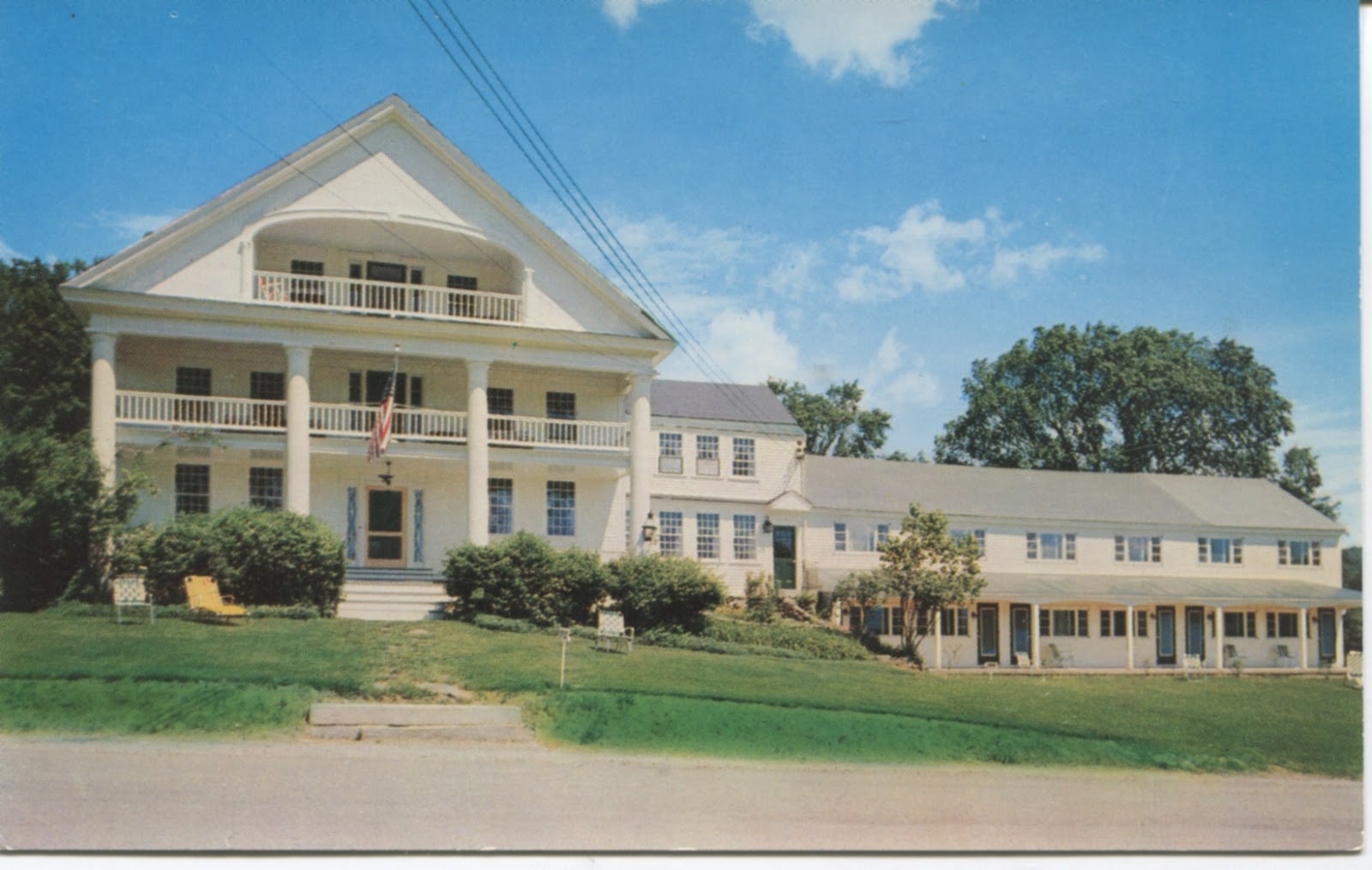
And here is a postcard featuring the inn with its "Motel" sign on the roof, from the days when Mr. Hull managed it along with the St. Johnsbury House. At some point, the Waterford Historical Society hopes to host a gathering of people who worked for Mr. Hull -- many worked in both locations at the time, according to the day's needs.

Monday, November 9, 2015

Lower Waterford's Gas Pumps in the 20th Century

Curran store and gas pumps at rear; house at front.
Fall foliage has settled onto the ground, and in Waterford, Vermont, snow is expected next weekend. Maybe it won't stay around long, but the ground is getting colder, and winter's around the corner.

Among the many discoveries and events this autumn was a well-attended and appreciated history walk around the White Village -- "Lower Waterford, Then and Now" -- led by Dave Morrison. He kindly agreed to sit down on another occasion to explain the Curran store and gas pumps that once stood on Route 18. Here is his explanation.


Waterford History, 20th Century: Mitchell and Gertrude Curran and Their Gas Pumps and Store; Other Gas Pumps; and the Rabbit Hill Inn

Information from Dave Morrison, in-person interview, Sept. 30, 2015

Mitchell Curran [1883-1954] and Gertrude Mabel (Baker) Curran [1881-1957] lived in the house that is labeled G. (George) Morrison on the 1875 Beers Map of Waterford. (George [1838-1906] and Kate/Katherine [1847-1928] Morrison were great-great-aunt and great-great-uncle to David Morrison.) The house stood on the west side of what was then the main road from Waterford to St. Johnsbury. Around 1930, the state of Vermont relocated Route 18 and negotiated for land from the Currans. Their land probably extended to Mad Brook Road, and the state had to buy some of it. Mr. Curran’s negotiation with the state included future state snowplowing on his newly elongated driveway, which had to extend much farther to meet the relocated roadway. Two other current houses have since been built on what would have been the Curran land.

“The Currans weren’t that into farming, and got the idea of having a store and gas station at the top of the hill” – that is, where today’s Route 18, leading out of Lower Waterford village, stops rising for a bit. They placed their gas pumps in front of a modest building on the related through-road, within walking distance of their house – and “behind” their home. There is a structure at that location today, a white house with attached garages; the double garage is where the store once stood with the gas pumps in front of it. In the 1930s thoses pumps sold Mobil gas. [As described later, the store was built by Kenneth Curran, Gertrude and Mitchell’s son.] Patricia Powers, in the 2004 Waterford Town Report, dated the start of the store and gas pumps to “the late ‘30s.” Dave Morrison recalls, as a small child in the early 1950s, having his mother pull him up the hill in a wagon, from the White Village, to go to the Currans’ store. There were cookies in a glass case; Hoodsie cups (Hood Dairy’s prepacked  ice-cream cups); and soda “in a pool of water where you put in a coin and slide the bottle to the gate.” The property included “a huge pull-off of several car lengths.”

Around this same time the Currans took over operation of the Lower Waterford Post Office. It had been run by Dave Morrison’s grandmother, who died in 1944 of a stroke; Dave’s mother and father then moved back into the family house (after just six weeks in their own place!) to take care of Dave’s grandfather. The Morrison family had a store that accompanied the post office, on Maple Street. Dave’s birth in 1946 made it too hard for his mother Dorothy to run both the store and post office, and Dorothy gave up the postal service (closing the store) to Gertrude and Mitchell Curran, who hosted the post office at their own location from 1946 to 1954. Their son Ken, who was particularly gifted with cement work, eventually built the Currans a new home adjoining their store, so they wouldn’t have to walk across the field from their original home.  That is the house currently seen at the location (attached to the double garage mentioned earlier). Their original home (currently blue) was then occupied by Milton and Marion Valentine and their daughter.

Mitchell and Gertrude Curran had two sons, Ken and Robert. Ken was an engineer and partner in the Curran–Lavoie contracting business in Littleton, NH, and took part in construction of Moore dam (1954-1957). When the road across the reservoir was being constructed in 1982, a very expensive bridge was included in the plans. Ken saw the possibility of skipping the bridge and creating the earth-filled segment now called “The Causeway” on which to lay Interstate 93, saving a great deal of money. The Causeway extends across a brook valley that entered the lake in the location that was the old village of Pattenville, NH, and Ken called the depression “the Pattenville draw.”  (Another small causeway was built to support Route 18 nearby.) The other son, Robert, lived at the round barn now owned by the Levy family, best known locally as the Hastings farm; Robert owned Curran’s Furniture in St. Johnsbury, located where Mayo’s Furniture now stands. [Dave’s guess: Kenneth was born 1910 or 1911; Robert, aka Bob, had children, including Peggy Curran (Bristol) Barber, whose recently deceased husband was Glenn Barber, Jr., living where Hastings Road goes off Daniels Farm Road.]

Mitchell Curran’s sudden death of a heart attack in 1954 ended the Curran post office and also rearranged the lives of the Morrison family. Dorothy Morrison, Dave’s mother, resumed being postmaster at the building that had been Dave’s grandparents’ home, where there was also a woodstove, but no store at this time. (Dorothy ran the post office until she retired in 1980, at which time the postal service moved into the Davies Memorial Library across the road.) At the same time, 1954, Dave’s father Arthur Morrison took a leave of absence from his job and invested all his funds into finishing the house that he and his wife had started back in 1941 (and had only lived in for 6 weeks; Arthur had puttered on the house during the intervening years).

Eventually the Currans sold the property to Earl and Lydia Stetson. “Earl needed a garage so he tore down the store and built the garage there” where the store had been. Mrs. Curran (Gertrude) moved to the end of Webster Street in St. Johnsbury, where she lived for the rest of her life. Dave recalls that his mother Dorothy saw the Currans as parental figures, so he often visited there with his mother.

Back at the original Curran place, as already mentioned, the next occupants were Milton and Marion Valentine and their daughter. After these, the Leon family moved in. Major Leon (who may have rented the place) came to the area as part of the project of building a radar base on East Mountain in East Haven, part of the DEW (Distant Early Warning) Line then being built to protect the United States from potential Soviet bomber attacks. Major Leon and his wife had three sons, of whom the oldest was Douglas. Douglas Leon showed Dave Morrison the old mineral excavation shafts on Rabbit Hill. [A note written by Patricia Powers in the 2004 Waterford Town Report gives the 2004 owners as the second Curran house, the one now on Route 18, as Raymond and Nancy Auclair.]

Other gas pumps in Waterford in Dave Morrison’s lifetime included City Service pumps at the brick (Begin; later Looking Glass Inn) house where Route 18 meets Interstate 93. A barn on that property was built twice. Dave believes there may have been dances at the barn after the second rebuild. That barn also is now gone, but driving past the property, the line of the existing driveway can be seen – it once separated house from barn, and continued across to the lower fields of today’s Gingue dairy farm, reaching Route 2 about a quarter mile east of the Route 2/Route 18 junction.

There were also gas pumps – Texaco ones – at the Whittemore place on Route 18, southeast of Lower Waterford village. Gladys and Earl Whittemore started that business in the 1950s, not many years after the Curran store went out of business. [Its name was the Countryside Service Station and Restaurant.]
Ad for the Whittemore restaurant and gas pumps, from 1963 Waterford cookbook.

Dave knew Earl Whittemore before the Whittemore business opened, as Earl worked at the lunch counter of Parker Drug Store in St. Johnsbury in the 1950s, perhaps 1952-1957; Dave’s parents after 1952 attended Sunday church services at Union Baptist Church in St. Johnsbury and would often give Earl a ride to his job in St. Johnsbury on Sunday mornings.

The Whittemore place began with just gas pumps and a stand that sold ice cream. Gladys Whittemore was a gifted baker, especially of pies, and the couple then operated a restaurant with their gas station. Dave recommends Barbara Douse, the Whittemores’ daughter, to give information and memories about that business.

Another business that Dave connected with as a youth was the Rabbit Hill Inn. He worked at the inn as he entered his teens, 1957-1964. In 1957, room rates were $10 single, $12 double. Alden Hull, a St. Johnsbury businessman [and father of Deborah Thornton], managed the St. Johnsbury (St. J) House (a hotel) then, and the Rabbit Hill Inn was purchased to be a satellite operation. Even the laundry was taken from Lower Waterford to the St. J House each day. Dave worked for the manager Anita DesTroismaisons Oakes, whose husband Kenneth Oakes worked for St. Johnsbury Trucking.

Where the safe [vault] now is, in the Town Office (lower floor of Davies Memorial Library building), in those years there was a garage door instead. It was installed with the dream of a firetruck for the village, to be parked in there. The dream was especially dear to nearby village resident Hamilton Allport (married to a daughter of the Davies family), who lived three houses away from the Davies Memorial Library, but the dream did not come to fruition. Instead, the Oakes family used the space as a garage while Dave worked at the Rabbit Hill Inn.

(report completed November 9, 2015 – BK)

Tuesday, August 18, 2015

A Call for Modern Photo Postcards

Facebook, Pinterest, and Twitter are the social media that have replaced photo postcards today - but these rectangles of stiffened paper last much longer! Here is an image, printed in the 1950s, of the "Rabbit Hill Motor Inn" in Lower Waterford. The photo was captured by Jenks Studio of St. Johnsbury, Vermont.

By dint of its age, the postcard is now an "antique." What should we be printing to make sure that today's lovely moments are captured for viewers 50 years from now?

Tuesday, October 21, 2014

Lower Waterford: Changes on the Main Road

The postcard above was mailed in 1909. You can see the town was already famous as a destination!

And here's one mailed in 1907:


But today's Lower Waterford Road, even though part of the stage route, was once a country lane, as shown in this postcard mailed in 1912:


Later that year, the inn would close -- part of a long intriguing tale told at the Rabbit Hill Inn website, http://www.rabbithillinn.com/about/inn-history -- and in 1957, it reopened, but as a "motor inn" owned by the St. Johnsbury House. Check out the sign on the roof!


In 1968, Ruth and John Carroll owned the inn, and later, Eric and Beryl Charlton:

Here's a Lower Waterford postcard from the 1990s, courtesy of Dave Kanell:


Today's Rabbit Hill Inn innkeepers are Brian & Leslie Mulcahy, and they will host, on November 2, the annual Apres Foliage Fest, an elegant get-together where the tickets and auction raise funds for the Davies Memorial Library, across the road.