Showing posts with label public event. Show all posts

Sunday, September 7, 2025

What Kind of Apples Grow Nearby? Mark Your Calendar!


The Waterford Historical Society announces:

 Stan Crane will present a program on various, ancient apples on Saturday,
September 13 from 1 p.m. to 4 p.m. The program will take place in the barn on
Walsh Rd., in Waterford at Donna Heath’s place. Drinks and slices of apple pie or
tarts and cider donuts will be available. Contact Donna Heath for directions, 802-748-3314.

Sunday, June 22, 2025

Summer Event: Wed. June 25, 6:30 pm, Butter Churns


 Everything's Better with Butter ... Churns! Join the Waterford Historical Society this Wednesday June 25 at 6:30 p.m. to learn about varieties of churns and their use. For directions (this is NOT at the library!), check with Beth at BethKanellAuthor at gmail dot com. And for a warmup of knowledge, look here.

Saturday, June 25, 2022

West Waterford Cemetery Rehab, June 25, 2022, Waterford Historical Society, VOCA, and More!

The first cemetery rehab session sponsored by the Waterford Historical Society, on June 25, 2022, was a resounding success! VOCA (Vermont Old Cemetery Association) members arrived before 8 a.m., to survey the lovely fenced cemetery and make a plan of action. Some came from as far away as Rutland, and their skills and teaching efforts are enormously appreciated.

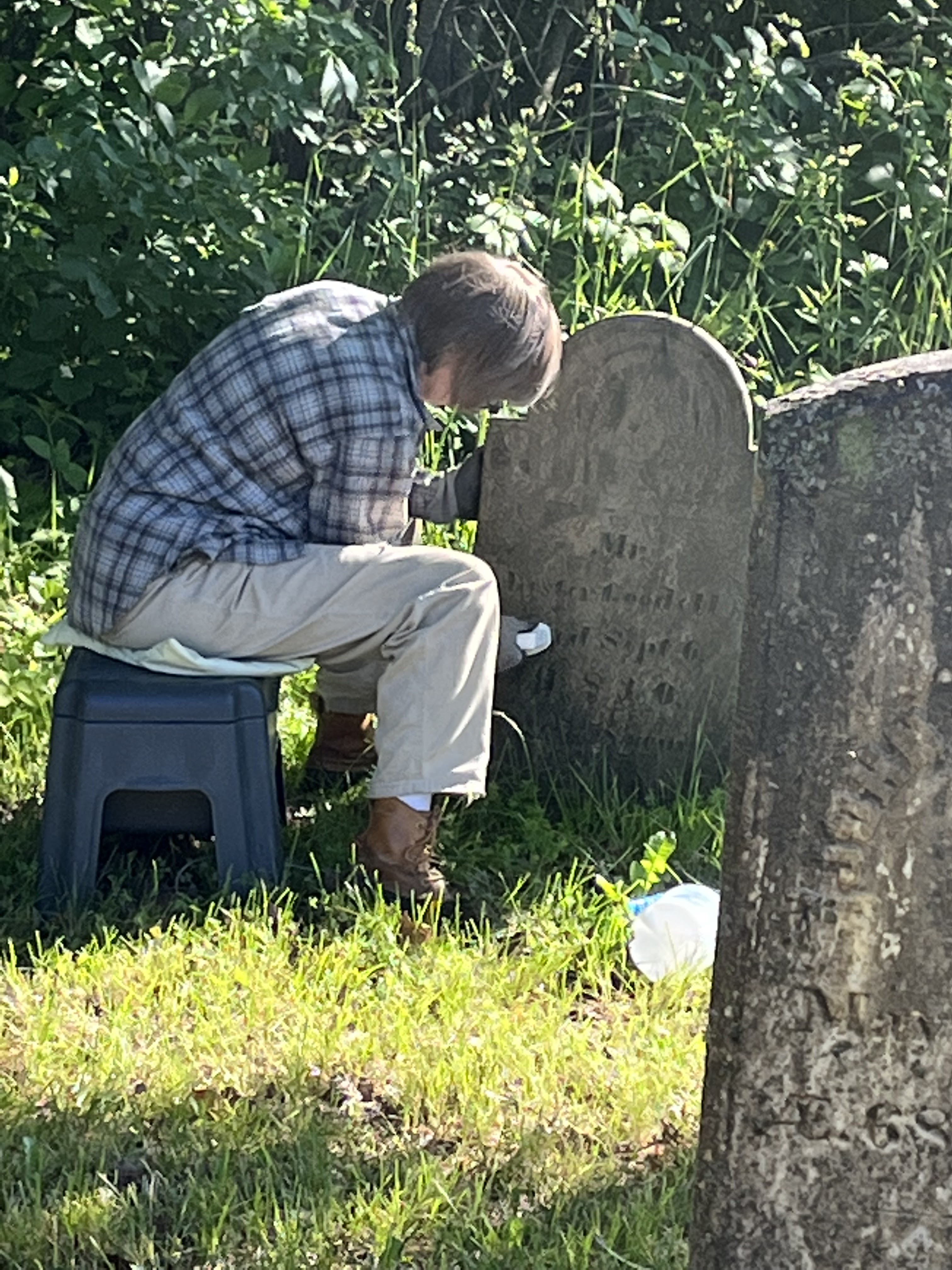
Here are some photos from the 4-hour session -- it was so rewarding to see the names emerge on the stones, and there will surely be more of these events. People joining us from other towns plan to also share the skills that the VOCA leaders taught today. THANK YOU, ALL!

VOCA members lift & straighten stones, as Joan Alexander of Glover looks on.

Nola Forbes of East St J, Waterford Historical Society and DAR member, tackles a stone on the shady side of the cemetery.

Nicole from Wilder, another VOCA pro, gives a basic lesson on cleaning the stones; Elizabeth Dean, Kacey Dean, Susan Hayes, (sorry, missed your name), and Donna Heath get ready for action.

Elizabeth Dean cleans one of the Bugbee family stones. She is an Austin family descendant.

Kacey Dean applies new skills to discovering long-hidden names here.

Christine Morey has her own list of stones in a neighboring town where she plans to apply her new skills.

Steven Carpenter-Israel maneuvers to lift crooked and sunken stones. His wife Wendy's family has roots in Waterford back to the 1700s.


Wednesday, May 4, 2022

Grandmother's Daylilies, Great-Grandfather's Onion Plants? May 7, Heritage Plant Swap


The White Birch Farm in Waterford (361 Route 18, not far from Route 2) will host a free event from 9AM til noon for people looking to share stories about their heirloom plans, and swap for another, with possibilities ranging from house plants to rhubarb to birch trees. 

The Waterford Historical Society also will be on hand to sign folks up for two upcoming events in June, including an order form from the The Rhubarb Kitchen for deserts in July.

Some pick-up services for plants in Waterford available on Friday May 6 -- email Beth at BethPoet at gmail dot com.


Many thanks to co-hosts Sam Haimovitch and the Ward/Conte family!


Friday, February 18, 2022

Celebrate Waterford's 225 Years with Cake and the Governor's Proclamation, on February 23rd


1858 map

                            Waterford History & Heritage Proclamation

It's time to celebrate Waterford, Vermont!

Please come join us for a reading of Gov. Phil Scott's decree honoring the historic 'naming' anniversary of Waterford. Residents successfully petitioned Montpelier 225 years ago to have their hometown's name changed from Littleton, finally ending a pre-Revolutionary era when Vermont lands were fought over by the provinces of New Hampshire and New York. Anniversary cake will be served. A 2022 calendar of history-related programs with community partners will be distributed. Brief election of WHS officers follows the celebration. Friends, neighbors, descendants and history fans warmly invited. Masks required.  

When:
Wednesday, February 23, 2022
4:30pm to 6:30pm
(UTC-05:00) America/New York

Where:
Davies Memorial Library, Lower Waterford

Organizer: Waterford Historical Society pikeprose@gmail.com


The Naming of Waterford


By Eugenia Powers

Typed and edited February 2022 by Betsy Carpenter


The area now known as Waterford was chartered under the name of Littleton on November 8, 1780, to Benjamin Whipple and his associates. This charter was issued by the Independent Republic of Vermont and signed by its governor, Thomas Chittenden.


The incorporation of Waterford as Littleton, Vermont, took place in 1791, after Vermont became the 14th state in the Union, and the town kept this name until 1797. We know this for a fact because two years later, on May 6, 1793, town government was organized at the first town meeting--held at the home of Nehemiah Hadley who lived near the river south of Lower Waterford Village--and the records of this meeting, as well as other meetings occurring over the next four years, are described as taking place in “Littleton, Vermont.”


But in March 1797, by an act of Legislature, the town was re-named Waterford. The question of why the town’s name was changed to Waterford specifically may never be fully answered. But there can no doubt as to the reason for making the change. Across the Connecticut lay Littleton, New Hampshire, and the possibility of confusion is almost unlimited in situations where towns of the same name exist so close to each other. So the residents of Littleton, Vermont, decided to take care of the situation. In a town meeting held in the old log meetinghouse on the river on September 6, 1796, they voted to petition the legislature “to alter the name of Littleton to Caledonia.”


The meeting that took this action was really two meetings—a town meeting and a freeman’s meeting. There are separate warnings for the two meetings in the Town Proceedings book, but the dates are the same. This was the third town meeting held that year. Most of the business of the three meetings was about schools and school districts. The action in the Freeman’s meeting was the election of John Grow, Esquire, to represent the town at the session of the Vermont Assembly which was meeting in October. At that time, John Grow was also Town Clerk and one of the selectmen. He had represented the town in 1795 and was re-elected in 1796, 1797 and 1798.


John Grow probably wrote the petition and carried it to the Legislature, which met in Rutland that session. Six weeks after the town vote, the State Papers of Vermont, Volume X, page 390, shows a petition from the town of Littleton requesting that the name be changed, not “to Caledonia,” but “to Caledonia or Waterford.” This was signed by all three selectmen—John Grow, Levi Goss and Daniel Pike. The date of the journal entry is October 19, 1796. Then in the Laws of Vermont for 1796-1799 on page 124, we find that the name was changed to Waterford on March 9, 1797.


When in this process did Waterford join Caledonia as a top candidate for the town’s new name, and why did Waterford finally prevail? Legislative reports do not contain the details of why things are done. Town records do not typically contain the arguments leading to a decision. Over the years, though, at least a couple of possible explanations have been explored by authors, including Esther Munroe Swift in her Vermont Place-Names: Footprints of History and C.E. Harris in his A Vermont Village.


The most obvious explanation—Waterford was so named because there were places in town where the Connecticut could be forded—may be too simple. Granted, there were spots in town where one could ford the river, but they were dangerous crossings. One such place was called the Basin. This was upstream from the upper village and is the spot where the Pikes crossed when they came to town. Traditionally, they held onto the tails of their oxen to save themselves in the rough water in case they slipped on the rocky river bottom. Perhaps Daniel Pike advocated for the name Waterford because he wished to commemorate this event.


The other place was below the upper village where a sandbar ran part way across the river. This spot was a reasonably good ferry site, but too deep really for a ford, at least part of the way across. Further, the sandbar could shift treacherously with the current.


It’s worth noting that the assertion of a ford existing at Lower Waterford is totally false. Any crossings made there were done after the dam at Gilman was constructed. Then it could be crossed on foot in the summer on a Monday. The water was held back at Gilman on summer weekends for use during the following week.


Another theory about the origin of the Waterford name is that the town’s earliest settlers had Irish roots and named it after Waterford in the southeast of Ireland. The place-name Waterford is, indeed, an old one, existing in England as well as Ireland and brought to this country by early settlers. But what do we know about the town’s earliest settlers? The names of the people living in Waterford, Vermont, as listed in the first census were Adams, Brown, Felton (which is probably Felch misspelled, since it is known that the Felch family was here at the time), Knoulton, Morgan, Pike, Potter, Sylvester and Wood.* They were all representatives of families that had lived elsewhere in New England before coming to Vermont—and, in some cases, elsewhere in Vermont.


These would seem to be a primarily Anglo-Saxon group, although some may have been Scots or English people who came to America by way of Ireland. In the course of the British oppression of Ireland, both English and Scots were encouraged to move to Ireland, as part of a policy to subdue the Irish rebels. But few of the people who migrated there were satisfied with conditions, and many moved on to America.


There is another matter of interest which might have a bearing on the selection of the Waterford name. Across the river from Hanover, N.H., were two confusingly-named towns – adjacent and both named for English towns. One of these, which contains the village of White River Junction, is still called Hartford. The town just south of it was originally named Hertford. The spelling and pronunciation of the two names was so much alike that Hertford petitioned the Vermont Assembly for a change of name.


The name was changed to Waterford by an act that was “read and concurred” on Saturday, June 15, 1782, and recorded in Governor and Council, Volume 2, page 156. But then on page 157 there is reconsideration of “the act mentioned in yesterday’s journal” and it was proposed to “alter the name of Waterford to Hartland.” So, as the Vermont History News reported in its May-June, 1980 issue, Hertford became Waterford for a weekend and then became Hartland, the name the town still bears.


The possible relevance of this legislative action to the re-naming of Littleton, Vermont, lies in the fact that several of its early residents were people who had lived in Hartland. The reconsideration of the name was the work of a Paul Spooner, a counsellor who lived in Hartland. We don’t know if there was a local controversy over the town’s new name, but perhaps those who moved to Littleton, Vermont, were among those who wanted Hertford called Waterford.


Silas Davison was one of these who came to Littleton, Vermont by way of Hertford/Waterford/Hartland, and John Grow’s wife, Deborah Davison, was the daughter of Paul Davison by his third marriage. Silas Davison was the grandson of Paul, his father being Daniel Davison, son of Paul by his first wife. So, John Grow may have had family influences operating on him when he wrote the petition requesting the name change to Caledonia or Waterford instead of just Caledonia. What the relationship was between the Spooner and Davison families is not known.


So, to the often cited but unproved reasons for why the town was named Waterford, we can add a third possible reason—also unproved. One day, perhaps with further research, we’ll know for sure.


Monday, June 7, 2021

WATERFORD'S WORLD, 194 Pages, by David J. Carpenter


For many years, Waterford residents have relied on the conversational town history assembled by Dr. C. E. Harris in 1941, A Vermont Village. Perhaps Dr. Harris would have quickly confirmed that he was no professional historian, but his achievement in assembling the material around him has given us a powerful foundation for examining the town's past.

David J. Carpenter

David J. Carpenter, whose mother was Beatrice Elizabeth Kinne of Upper Waterford, labored for decades to take the work further and deeper. He too was not a historian by training, but his forestry education and his U.S. State Department career both impacted his research and writing. Though he was not able to complete his grand outline of the town's story by the time of his death in 2013, he provided the first half of it for the willing editorial hands of his daughter Betsy Carpenter.

Now that history, taking Waterford from its frontier settlement years in the late 1700s, to the aftermath of the Civil War, is available in polished and highly readable form, thanks to Betsy. It's a remarkable work, with discreet footnotes that don't interrupt the compelling reading. The "Tribute" at the front of the book WATERFORD'S WORLD gives a sense of David J. Carpenter's love for the town and its past as he described the view from the ridge on the east side of town:

On a clear night the lights of farms and distant villages gleamed silently in place. Quiet sounds from the woods bespoke the private world of the guardian creatures of the hill In the dark sky above, Polaris lit a path across the north side of the big field of sheltering stars.

And now, in the valley below, you can touch the faint presence of the past at the cellar holes, beside the stone walls, along the thrown-up roads and in the graveyards, where those who came before us lived, and worked and died, and entrusted to our care the prized legacy of this special world—this town.—DJC

The book probes the facts available about noted early settlers James and Submit Adams, explores religious frictions in the town in the early 1800s, and details Waterford's industrial and agricultural growth through that century. Family diaries add specifics, like the ones about the Ladd family members. And there are more journal entries from Waterford's contribution to battles in the War of Rebellion (the Civil War).

Treasures in the book.

Betsy Carpenter plans to take part in the Waterford Historical Society's Rhubarb Festival on Saturday June 19, 11 a.m.-2 p.m., at the Conte place by the intersection of Route 18 and I-93 (uphill from today's Pettico Junction Country Store corner) -- older town residents will know the location better as the Begin place, or even as White Birch Farm, its moniker from when the Ide family owned it. She will bring copies of the new book for purchase. They may be limited in number, so pre-ordering with a phone call TODAY to Roberta Smith (treasurer of WHS: 748-0923) is a good idea.

This book will be treasured doubly: in the pleasure of reading it, and as a resource for years to come.


INDEX:


Wednesday, May 26, 2021

Seasonal Desserts Take the Stage at Waterford Historical Society's Rhubarb Festival


Rhubarb used to be called "pie plant" in New England -- and today's cooks combine it with strawberries, or lemon juice, or butter and brown sugar, turning it into seasonal desserts that tickle the tastebuds.

Get your rhubarb treats the easy way by pre-ordering them from the Waterford Historical Society! They will be wrapped and ready for pick-up, safely and simply, on Saturday June 19 from 11 to 2, at White Birch Farm (aka the Begin Place), next to the junction of Routes 18 and 93.

Orders should be received by June 7 for the bakers to get busy; here's an order form for this delicious funraiser!

Wednesday, April 21, 2021

May Is Historic Houses; June Is Our Rhubarb Festival!

The "tontine" structures in Lower Waterford.

What do you know about your home's history? How could you find out more about your house and the people who built it, then perhaps lived there? What would you to remember later about how you've invested part of yourself in your house?

All these, and much more, will be part of the Waterford Historical Society's May 26 meeting with a specialist in house history -- and this will be a Zoom'd event, perhaps the last one we'll need to do that way (hurrah!). Watch for more details soon.

June Is for Rhubarb Desserts and More


Mark your calendar for June 19, when the Waterford Historical Society and the Conte family host a drive-through Rhubarb Festival (our annual fundraising event) at White Birch Farm (aka the Begin place; on Route 18, near exit 1 from I-93). Bakers, get your recipes out -- we're eager for your special rhubarb dessert treats, from crumbles to pies to maple rhubarb muffins (yummy!). To inspire you, here are a couple of recipes from Yankee Magazine with new variations on old treats

Raspberry Rhubarb Pie (Yankee)


unbaked pastry for double-crust, 9-inch pie

3 cups chopped fresh rhubarb

1-1/4 cups sugar

3 tablespoons all-purpose flour

pinch of salt

2 cups fresh or frozen raspberries

1 tablespoon butter, cut into several pieces


Preheat the oven to 450°F. Line a 9-inch pie plate with pastry for the bottom crust.

In a bowl, combine rhubarb with 1 cup of sugar, flour, and salt. Allow to stand for about 10 minutes. In a separate bowl, combine raspberries with remaining ¼ of cup of sugar.

Pour rhubarb mixture into pie plate. Drain raspberries and layer on top of rhubarb, then dot with butter. Cover with the top crust and seal edges.

Bake for 15 minutes. Reduce heat to 325°F and bake for 30 more minutes, or until pie is golden brown.


Cherry-Rhubarb Crunch (Yankee)


Crust

1 cup quick cooking oats

1 cup brown sugar

1 cup flour

1/2 cup (1 stick) butter

pinch of salt


Mix together all of the ingredients and press half of the mixture on the bottom of a 9x13-inch pan.


Filling


4 cups diced fresh rhubarb

1 cup sugar

1 cup water

2 tablespoons cornstarch

1 teaspoon almond flavoring extract

1 can cherry pie filling mix

1/2 cup chopped nuts


Preheat oven to 350 degrees F.

Spread the diced rhubarb on top of the crust. Boil the sugar, water, and cornstarch until thick. Add the almond flavoring, then the pie filling, and spoon the mixture over the rhubarb. Sprinkle the remaining crust mixture over it, then the nuts. Bake for 45 minutes.

Serve warm with whipped cream or ice cream.

Sunday, April 4, 2021

Waterford’s History Is on Display in Montpelier


photos by Donna Heath & Helen Pike

It’s lively, it’s local, and it’s uniquely Waterford: the hands-on archaeology “dig” that’s become an annual feature of the Waterford Historical Society’s partnership with Waterford School and local landowners. Now, from April 7 to July 31, it’s also on display at the Vermont History Museum at 109 State Street in Montpelier.


The exhibit features energetic approaches from 14 local historical societies, focused on the stories people share about their families, events, and grasp of the very personal past. Waterford’s portion shows students from the school, examining the remains of dairy farming at the Hale-Bonnett-Koeppl farm on Lower Waterford Road.


Also in the exhibit, visitors can find information on the hundreds of other local history organizations around the state via an online directory kiosk, and can “Build Your Own Historical Society” choosing objects for their own historical society, using examples from participating organizations and the Vermont Historical Society. 

Support for the exhibit is provided by the Alma Gibbs Donchian Foundation. Current hours are 10 am–4 pm, Wednesday­ through Saturday (see vermonthistory.org for updated hours and visitor guidelines).


* *

To browse more material on this blog, click here, and note the white search box at the top left corner. 


Saturday, February 20, 2021

Discovering Waterford 2021: Our Rhubarb Festivals

Rhubarb festival prizes.

2015's event.

Most farm properties, and many home gardens, in Waterford are host to the traditional "pie plant," rhubarb. We chose this classic New England treasure for the annual fundraiser gatherings of the Waterford Historical Society. Yes, there WILL be a rhubarb festival event this June, too! We are planning one that can be "pandemic safe" -- watch for details.

Meanwhile, here are reminders of some of our rhubarb events, and a link to the recipes is here, too!

Tuesday, March 10, 2020

March 25 Meeting: CANCELED for Community Health Concerns

Sorry to cancel the in-person gathering. BUT: Material from this presentation will be posted online soon -- keep an eye out!

What does a woman's right to vote mean in Vermont? Rural farm historian Donna Rae Heath reflects on how this right developed over the past century, and what it means to her today.

Sunday, September 15, 2019

Barns Crammed With History: Digging Into a Waterford Farmyard

Industrial hemp farming at the Gingue Farm.
Waterford's barns stand for large parts of the town's history, but more and more often, their usefulness dwindles with changes in land use and even in the kind of farming being done. For example, the Gingue Farm, in the district where the Hill family resided in Waterford Hollow in the 1800s, has now left behind dairy farming, for the pleasure and adventure of diversified farming -- going well beyond the farm's traditional rows of sweet corn, to industrial hemp and grains for craft brewing.

"The dig" at a historic barn's foundation.
 But some barns carry so much history with them that the owners invest in keeping them standing, even without a farm use at this point. At the September 25 Waterford Historical Society meeting, a very special set of barns will be identified, as two WHS members demonstrate how some gentle digging around the barn foundations can reveal amazing details of daily life from more than a centure in our past.

Join us at the Davies Memorial Library, on Wed. Sept. 25, at 6:30 pm, for this fascinating presentation from Donna Rae Heath and Craig Brown. Free to the public, partially accessible (rest room downstairs), and of course, local refreshments on hand!

Sunday, July 7, 2019

Waterford's Racing History Rides Again: Saturday July 13, 2019

The history and living stories of the Northeastern Speedway get a refresher again this summer, with a reunion event that includes a tour. You don't have to drive at high speed to attend! Bring your curiosity (and a few kids to run around if you like). Details:


And for more about the track and its history as the "birthplace of auto racing in Vermont," click here.

Wednesday, June 12, 2019

The Two Wives of Jonathan Ross, Vermont Supreme Court Justice

Waterford's June 15 celebration (this Saturday!) includes an appearance by Justice Jonathan Ross (1826-1905), as re-enacted by the town's much-admired thespian Bill Vinton. So I paused today to take a look at Judge / Justice Ross's family history.


It's easy to determine that he was married twice: first to Eliza Ann Carpenter, born in Waterford herself (brother of Amos Bugbee Carpenter, the West Waterford postmaster for so many years). Together they had eight children. Eliza died at the age of 60 (1826-1886; those eight children could have played a factor), and Jonathan then married Helen Augusta Daggett. Records online indicate Helen's birth in Coventry, Vermont -- yet the cemetery stone placed to celebrate Jonathan and his spouses indicates she was born in Waterford! It seems unlikely that the judge would make a mistake like this ... I wonder what actually happened, and who determined what the stone would say?

Because this aroused my curiosity further, I made a quick check of the Civil War draft records, and found Jonathan Ross listed in the major state draft of 1863. He was by then 37 years old and an attorney; it appears he never saw service, although at that age, he could have ... but seems to have been too busy at home. (Eight children and a law office.)

What more may be revealed about this impressive Waterford gentleman? I'm eager to find out on June 15. [As of this writing, there are still tickets available!]

Sunday, June 9, 2019

Buy Tickets by Thursday Evening for Saturday's Fun!


Festivity and Drama for 160th Anniversary of Lower Waterford Church
[Photo: Jonathan Ross engraving in the public domain]

WATERFORD – A celebration to honor the 160-year-old Congregational Church in Lower Waterford is slated for Saturday, June 15.
“For God, Country and Rhubarb!” is the theme of the special, two-part benefit hosted by the church and the Waterford Historical Society.
The Community Room door on Maple Street opens at 5:30 p.m. for a rhubarb-flavored dinner with pizzas donated by Kingdom Crust in Saint Johnsbury and cheese from Crooked Mile Farm, here.
“We’re so grateful to Aaren James for his generosity,” said Norrine Williams, a member of the church’s leadership team. Ticking off traditional, and separate, toppings of meat, vegetables and cheese, she continued, “Kingdom Crust’s pizzas are delicious.”
Noting that James bakes with King Arthur Flour that contains no GMO additives, Williams added, “We’re thankful he’s also willing to make a gluten-free pizza for our guests.”
Two specialty pizzas combining goat cheese from the micro-dairy goat farm, with rhubarb and spinach are on the menu as well. Acting on a suggestion at Town Meeting by cheesemaker Roberta Gillott, WHS president/secretary Helen Pike made a sample that received a favorable response at the May historical society program.
Gillott had participated in the first joint benefit in 2014, “Barn to Table,” because of her location on the historic Johnson-Powers Farm on Old County Road South. Added Williams, “We’re thrilled Roberta is donating one of her flavorful cheeses again.”
The dinner includes many different rhubarb desserts organized by WHS treasurer Roberta Smith who also will make a birthday-themed cake for the 160th celebration. The menu includes homemade pasta salad, a fresh garden salad with a variety of dressings, including a rhubarb vinaigrette. For beverages, there will be rhubarb switchel, lemonade, water and hot tea and coffee.
At 6:45 p.m. sanctuary doors open for “Supreme Court Justice Jonathan Ross tells all – or most!” as historical interpreter and St. Johnsbury Academy theater director Bill Vinton brings Waterford farm boy-turned-lawyer back to his hometown with stories about the church, his career in St. Johnsbury, legal opinions in Montpelier, and even his brief stint in the U.S. Congress. Last month, the WHS donated to the Davies Memorial Library "The Law of the Hills," a concisely organized book that looks at the state's judicial history by Paul S. Gillies. It includes an entry on Ross.
Proceeds raised from the June 15th benefit are earmarked for the historical society’s oral history project and the church’s much-needed interior restoration.
A disastrous fire on June 30, 1859 levelled the previous Lower Waterford meetinghouse. But parishioners repurposed timbers, pews and deacons’ benches from the 1818 meetinghouse built on a Mad Brook hillside with new materials. They dedicated their Greek Revival-styled church on January 11, 1860.
“Waterford has always had the faith of a mustard seed,” said Rev. Ann Hockridge about the spirit of cooperation between both organizations to build a modern sense of community in a village where most buildings date from the late 18th century.
            From 1860 until 1957, when the unified elementary school opened on Duck Pond Road, the current building served as the location for Town Meeting which took place downstairs in the vestry. The sanctuary hosted 8th grade graduation ceremonies from the town’s 14 district schoolhouses. A special Church Town Committee is exploring ways that might allow for a renewing of the building for municipal purposes.
Hallmark photographer Winston Pote of East Lancaster, NH, brought the Congregational Church and Lower Waterford international fame when he put the village on chrome postcards that were sold and sent by the thousands, beginning in the second half of the 1950s.
There is separate ticket pricing for the dinner and performance and for the performance only. Dinner reservations are limited to 90 and are expected to go quickly. Tables can be arranged for parties of two, four, five and 10. Reservations will be accepted until 8 p.m. Thursday, June 13. For more info, or to RSVP, please contact Helen Pike: 802-748-0180.


Wednesday, May 8, 2019

Wedding Bells in Waterford, Vermont


The Waterford Historical Society presents "Waterford Weddings and Fashions" with historian Nola Forbes on Wednesday May 22 at 6:30 pm at the Lower Waterford Congregational Church. In planning this presentation, Nola Forbes reflected, "[Wedding gowns] brought to the meeting can be draped over sheets placed over pews, and perhaps held up when discussed.  At the moment we have samples from different time periods; of these, most were not worn in this church. Connie Quimby hopes to bring the 1873 dress worn by Geneva Powers Wright's grandmother Sarah Gilbert Powers to display. Photo of Geneva modeling it in 2012.  Beth [Kanell] has her mother's dress that she also wore (1950; 1971; 1980).  I have my grandmother's 1915 dress that I also wore in 1972.  I have my daughter's 1997 dress she & I made. Roberta hopes to make a wedding cake as part of refreshments. I have a story of Carpenter-Kinne 1909 "daisy" wedding, but unclear if it actually took place in the church or perhaps at Nathan Kinne's home in Waterford."

Of course, Waterford is a noted wedding destination today because of the Rabbit Hill Inn (see romantic photos at the inn's website: https://www.rabbithillinn.com). But there are many notes of marriages in the past in this Connecticut River town -- and some, like the "daisy" wedding just mentioned, must have embraced traditions different from today's. In 1877, Cosbi Bowman (Parker) Carpenter wrote to her son that "All is quiet here now, there was to be a China wedding up to Mr Wells the first of May." I wonder what a China wedding was?

Surprises also emerge in sifting through Waterford history -- as when yours truly (Beth) discovered a cousin of hers, Jennett Cutler Batcheller of Bethlehem, New Hampshire, who in 1856 married one of Waterford's Bugbees:


 It's especially exciting that Nola Forbes is making the May 22 presentation, since her team of Daughters of the American Revolution recently reviewed all the local church records -- who knows what other wedding stories maybe rediscovered!


Saturday, April 13, 2019

Listen to Aunt Ida’s Diaries (1918-1951) on Wed. April 24

"Aunt Ida," Ida Richardson Caswell Pike, circa 1890 while she was Mrs. Caswell. She is sitting on the porch in Upper Waterford, a village of the town that vanished in the wake of the power dams.

 
WATERFORD, VT – For this riverfront community whose fate changed forever with the construction of Comerford and Moore Dams, finding evidence of how lives were lived is a challenge.
             On Wednesday, April 24, at 6:30 p.m., the Waterford Historical Society (WHS) will share entries from the diaries of Ida Richardson Caswell Pike, a descendant of one of Waterford’s founders from Royalston, MA, who lived most of her life in Upper Waterford until Moore Dam was built.
            The small, slim volumes, written in pencil, are among the ephemera inherited by WHS president/secretary Helen-Chantal Pike when her father, who was Ida Pike’s nephew, passed away. Robert E. Pike, who died in 1997, is best known for two books about the greater Connecticut River Valley’s logging history that are still in print, “Tall Trees, Tough Men” and “Spiked Boots: Sketches of the North Country.”
            From 1918 to 1951, the diaries span the final years of Ida’s first marriage to businessman Charles Caswell through her subsequent marriage to his partner, Harley E. Pike, an Upper Waterford farmer whose ancestors also helped settle Waterford after the American Revolution.
            Pike also served on the Waterford Select Board for 24 years, and some of his wife’s diary entries cover natural disasters, what residents did to raise money for the town’s one-room schoolhouses, and the 1934 construction of the Route 18 bridge linking Lower Waterford to West Littleton, NH, signaling the end of Upper Waterford as the town’s commercial crossroads between Portland, ME, and Burlington, VT.
            Free and open to the public, this program will take place in the sanctuary of the Congregational Church in Lower Waterford. In the foyer, visitors have the opportunity to view models and other objects relating to the town’s history and ask questions of the WHS, which is actively engaged in historical detective work, including family genealogies, to bring Waterford’s past to life. Sweet and savory refreshments also will be served.
        
  
"Aunt Ida" with her second husband, Harley Pike, 1956 in their new house in Littleton NH.
           

Sunday, March 10, 2019

Northeastern Speedway in Waterford Had a Children's Discount

The March 1, 2019, issue of the Caledonian-Record included this image of children's admission tickets for the Northeastern Speedway. Nice to see that they had a special rate!

With thanks to the Northeastern Speedway for the image, and Dave Kanell for the scan.

Visit http://www.northeasternspeedway.com to see more of the track history (note that the image came originally from that website). We'll post a reminder when the summer event for this historic track begins to be promoted.